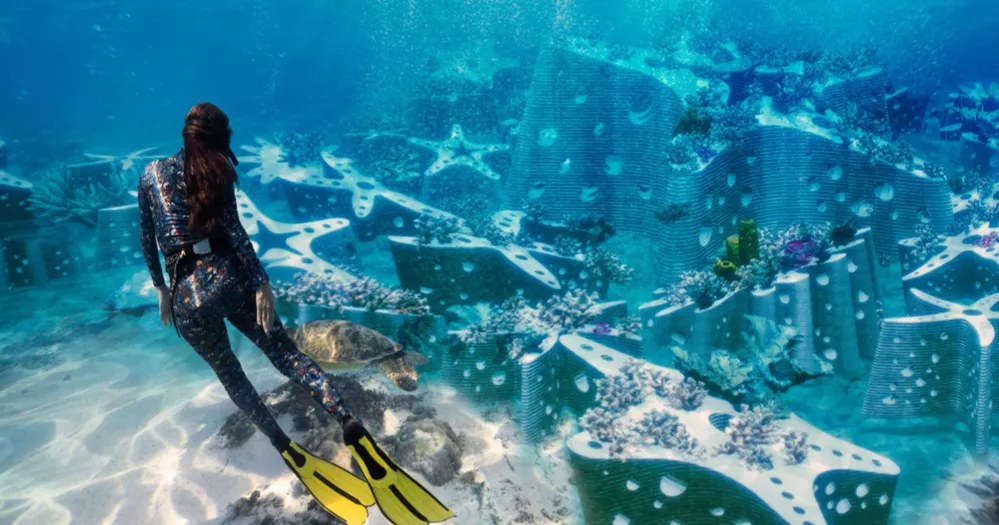
South Florida is welcoming a new fleet of cars — but these won’t clog traffic or add to commutes. They’re made of marine-grade concrete and rest beneath the ocean surface off South Beach.
In late October, crews submerged 22 life-sized car sculptures several hundred feet off the Miami coastline as part of “Concrete Coral,” a project by the nonprofit REEFLINE to create an underwater sculpture park that doubles as a human-made coral reef.
Funded in part by a $5 million Miami Beach city bond, the installation will soon be seeded with 2,200 native corals grown in a local lab. REEFLINE aims to raise $40 million to expand the project into an 11-phase underwater art corridor stretching along the city’s seven-mile (11-kilometer) shoreline.
“I think we are making history here,” said REEFLINE founder Ximena Caminos. “It’s a one-of-a-kind, pioneering reef that brings science and art together.”
Designed by artist Leandro Erlich, the submerged cars will soon become home to thriving coral and marine life, said Colin Foord, who heads REEFLINE’s coral lab. “Nature’s going to take back over, and we’re helping by growing the soft corals,” he said.
Future phases will include “Heart of Okeanos,” a massive sculpture modeled after a blue whale’s heart by Petroc Sesti, and “The Miami Reef Star,” a large star-shaped installation by artists Carlos Betancourt and Alberto Latorre.
Miami Beach Mayor Steven Meiner said the project will also boost local jobs and eco-tourism through snorkeling, diving, and paddleboarding tours. “Miami Beach is a global model,” Meiner said. “We’re setting the blueprint for other cities to follow.”
City strolls can be as beneficial as nature walks, say researchers
REEFLINE also offers hands-on education programs, inviting volunteers to plant corals alongside scientists and take part in monthly conservation activities through a floating marine learning center.
Caminos said while the project cannot solve major environmental challenges like climate change or sea level rise, it can inspire awareness and collaboration. “We can show how creatively and collaboratively we can tackle man-made problems with man-made solutions,” she said.
Source: AP