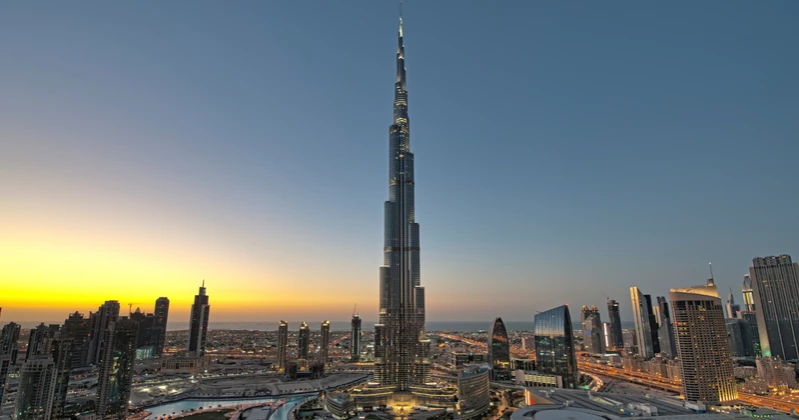
Burj Khalifa, the world’s tallest tower, has become a global icon since its inauguration in 2010, symbolising the United Arab Emirates’ ambition, growth, and architectural prowess. Soaring 828 metres into the sky, the building has redefined luxury and remains a magnet for both tourists and locals, with observation decks on levels 124, 125, and 148 offering panoramic views of Dubai.
Purpose behind Burj Khalifa
The primary goal of constructing Burj Khalifa was to create a landmark for Downtown Dubai that would attract tourists and investors while serving as a hub for economic activity. The vision was to design a vertical city encompassing residences, luxury hotels, tourist attractions, and corporate offices. By doing so, Dubai aimed to diversify its economy beyond oil, drawing global investment into real estate, business, and tourism. Backed by the UAE government, the project was intended as both an architectural and economic statement.
Construction journey
Construction began in 2004, led by architectural firm Skidmore, Owings & Merrill (SOM), with Adrian Smith as the chief architect and Bill Baker as the structural engineer. The design process involved rigorous studies on wind resistance, material strength, and temperature variations along the building’s height, pushing engineering boundaries.
The tower was completed in October 2009, just over five years after construction began. Among its remarkable features are the 26,000 exterior glass panels, each weighing 362 kg, installed by more than 300 Chinese cladding specialists — a world record for aluminium and glass façade installation at 512 metres. The telescopic spire, the building’s crowning feature, contains 4,000 tonnes of structural steel and houses communication equipment, with xenon lights flashing 40 times per minute to prevent collisions.
How Dubai’s Burj Al Arab became the world’s ‘only 7-Star Hotel’ amid Iran strikes
Burj Khalifa’s infrastructure is equally impressive, with 57 elevators, eight escalators, the world’s tallest service elevator capable of carrying 5,000 kg, stairways reinforced with fireproof concrete, and a water system supplying an average of 946,000 litres daily.
Economic impact
The project cost $1.4 billion and was officially opened in January 2010. Named in honour of former UAE president Khalifa bin Zayed Al Nahyan as a gesture of gratitude for financing, Burj Khalifa has since become a major economic driver. Entry ticket sales alone generate $621 million annually, and the residential units have earned $2.18 billion since 2010, with over 76% priced above $1 million. The tower draws millions of visitors and investors, significantly boosting Dubai’s economy.
What’s inside Burj Khalifa
Burj Khalifa combines luxury, business, and lifestyle under one roof. It houses the Armani Hotel on floors 1 to 8 and over 900 private Armani residences from levels 9 to 108, designed by Giorgio Armani. Corporate suites, observation decks, spas, gyms, and swimming pools extend up to level 154.
For dining, Atmosphere on level 122 is the world’s highest restaurant from ground level, offering spectacular views alongside fine cuisine. Beyond its height, the tower features the most floors, the highest elevators, the tallest habitable floor, and the highest residential apartments in any building worldwide — truly embodying the concept of a vertical city.
Burj Khalifa remains a landmark of ambition, luxury, and innovation, cementing Dubai’s place on the global stage.