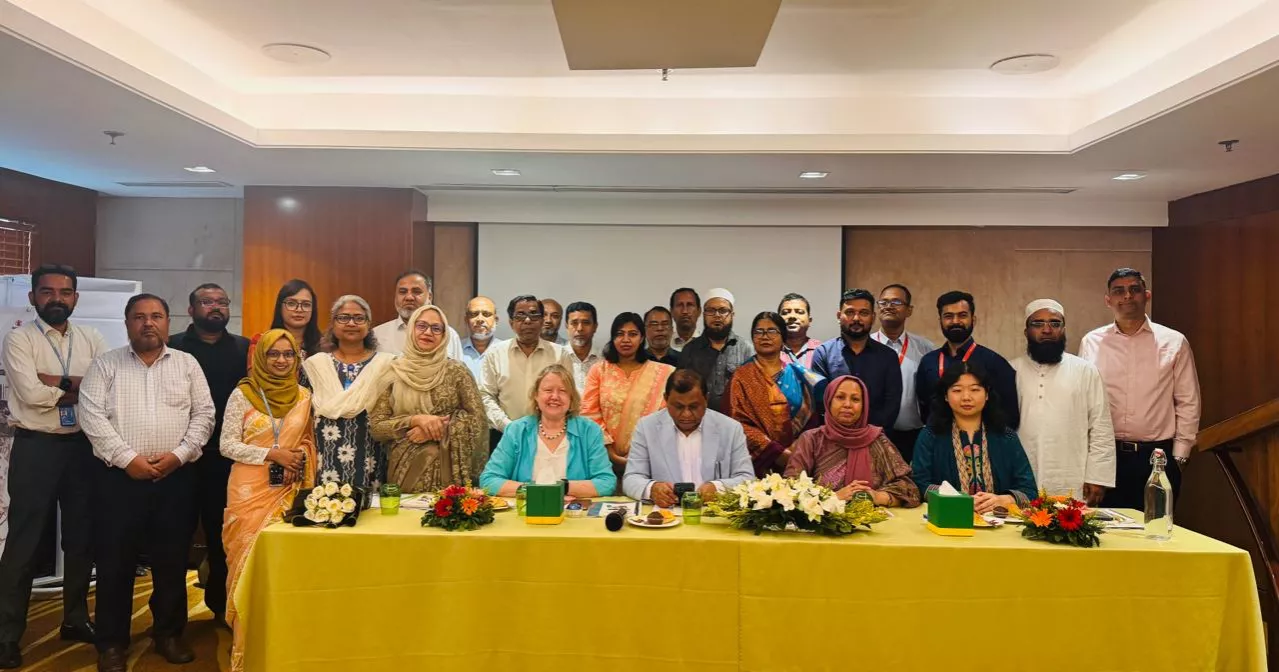
A three-day national workshop at Holiday Inn, Dhaka, under the Climate Smart Education Systems Initiative (CSESI) wss held to assess existing capacities and strengthen climate risk analysis for the education sector.
To support evidence-based policy planning and build institutional readiness, the Ministry of Education (MoE) and the Ministry of Primary and Mass Education (MoPME), with UNESCO, the UNESCO International Institute for Educational Planning (UNESCO-IIEP), Save the Children, and support from the Global Partnership for Education (GPE), launched the workshop.
Running from 10 to 12 May 2026, the workshop brings together over 30 officials, technical experts and education planners from national and sub-national levels.
Inaugurating the workshop, the Chief Guest, Mr. Abdul Khaleque, Secretary, Secondary and Higher Education Division, Ministry of Education, said, “This workshop is particularly significant because it focuses on examining the capacities we already have within our system and identifying where further strengthening is needed
Speaking at the event as the Guest of Honour, Dr. Susan Vize, Head of Office and UNESCO Representative to Bangladesh, said, “This workshop moves beyond identifying risks and focuses on understanding the existing capacities, systems, and institutional mechanisms required to address those risks effectively. Strengthening evidence-based planning, improving coordination and enhancing preparedness at both national and sub-national levels are essential to ensure learning continuity and protect the wellbeing and future of children and young people.”
Special Guest Bodrun Nahar, Additional Secretary (Development), MoE also addressed the opening with special focus on climate data and climate financing for education. Participants represent SHED, DSHE, BANBEIS, NCTB, DPE, BMD, University of Dhaka, district and upazila Education officers among others. UNESCO-IIEP specialist Ms. Yi Shi is leading the technical facilitation alongside the UNESCO Dhaka Office and Save the Children International.
Bangladesh remains one of the most climate-vulnerable countries in South Asia. According to the 2025 Notre Dame Global Adaptation Index, Bangladesh ranks 178th out of 187 countries, while national education data show that nearly 16,000 educational institutions were affected by climate-related disasters in 2023.
Rising temperatures, changing rainfall patterns, floods, cyclones, and salinity intrusion continue to affect school attendance, infrastructure, and children’s learning outcomes. UNESCO-IIEP’s climate risk analysis also shows that while Bangladesh has strong policy foundations on climate resilience, climate adaptation is not yet systematically integrated across education planning, teacher development, risk assessments, and infrastructure planning.
The workshop is part of a broader national process under the Climate Smart Education Systems Initiative, which began in Bangladesh in 2024 with a joint scoping mission and country work planning process.
In October 2025, Bangladesh held its first national workshop to identify and analyse climate hazards, vulnerabilities and risks facing the education sector.