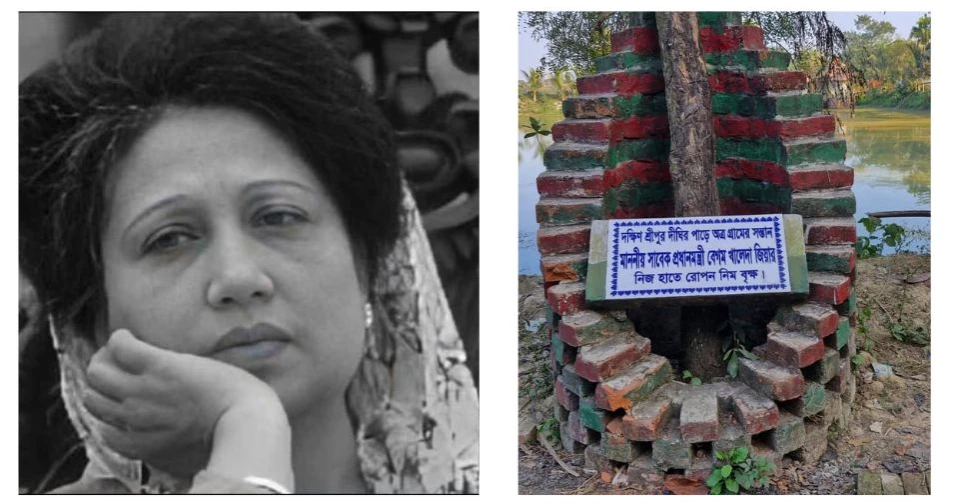
At the gate of Majumdar Bari in Fulgazi, Feni, a neem tree planted decades ago by BNP Chairperson Khaleda Zia still stands, quietly preserving a living memory of her ties to the ancestral home.
Back in 2008, during a visit to her ancestral house, Majumdar Bari at Shreepur village of Fulgazi Upazila, Khaleda Zia planted a neem tree on the banks of the South Shreepur Dighi pond.
Over the years, the tree grew under careful care and a tile bearing her name was placed at its base. Today, the tree stands as a silent tribute to her presence.
Khaleda Zia, former three-time Prime Minister and BNP Chairperson, passed away on Tuesday (December 30) at 6:00 am while undergoing treatment at Evercare Hospital in Dhaka.
Upon hearing the news of her passing on Tuesday morning, the residents of Fulgazi were seen weeping openly.
At her ancestral home, people gathered near the neem tree, taking photographs, remembering her as a living part of Majumdar Bari.
For them, even in her absence, the tree serves as a lasting memory of Khaleda Zia.
Majumdar Bari holds numerous personal relics of Khaleda Zia’s life—the chairs she sat on, a small cot she used for rest, and the dining table, all bearing the mark of her touch.
Farewell to a leader; Khaleda Zia laid to rest with state honour
Neigbours and family members recall that during her 2008 visit, Khaleda Zia also paid respects at the grave of her grandfather Salamat Ali Majumdar before beginning her election campaign.
Her cousin, Shamim Hossain Majumdar, said, “She always showed respect to elders and gave immense affection to the young ones. The nation has lost an irreplaceable leader. This loss can never be filled.”
Khaleda Zia also contributed to her ancestral area by establishing several institutions, including madrashas, mosques, schools and colleges for people.
Her death has cast a shadow of mourning in Fulgazi and the entire Feni district.
According to BNP’s website, Khaleda Zia was born to Iskandar Majumder and Taiyaba Majumder on August 15, 1945, in Dinajpur district. She is the fourth among her four sisters and two brothers.
Throughout her leadership of BNP, Khaleda Zia earned respect not only from her followers but also across political parties. Analysts describe her as a unifying figure, a champion of democracy, and a symbol of perseverance who transformed Bangladesh’s political landscape, paving the way for women to lead at the highest level.
Her ancestral home in North Shreepur village, Sadar Union, Fulgazi Upazila, Feni, remains a symbol of her enduring legacy.
Nomination papers were submitted on behalf of Khaleda Zia from this constituency for the 13th parliamentary election on Monday.