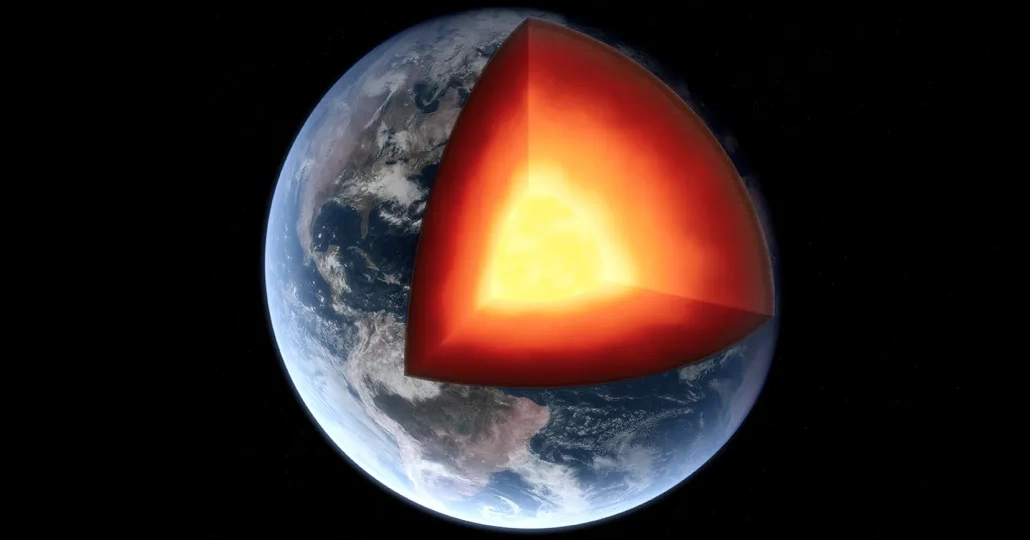
The oceans are the largest entity on Earth’s surface. All that blue, however, may be dwarfed by an immense reservoir of hydrogen concealed in the planet’s heart. Experiments indicate that enough hydrogen to form dozens of oceans of water may have been entombed in Earth’s core during its formation, researchers report February 10 in Nature Communications. Those chthonic reserves may influence processes on the planet’s surface.
Hydrogen does not exist as liquid water in the core. However, as it slowly moves upward into the mantle, it can react with oxygen to form water, said geodynamicist Motohiko Murakami of ETH Zurich. Oxygen is one of the most abundant elements in mantle minerals, making such reactions possible.
Previous estimates of hydrogen in the core varied widely and relied on indirect methods. Scientists had measured how much iron expands when hydrogen is added to it to estimate hydrogen content. In the new study, Murakami and his team used a more direct experimental technique.
They created artificial samples resembling early core material by enclosing small pieces of iron in hydrogen-rich glass. The samples were then compressed between two diamonds in a high-pressure device and heated with a laser to temperatures reaching 4,826 degrees Celsius.
Under these extreme conditions, the materials melted into iron droplets containing silicon, hydrogen and oxygen. Scientists believe Earth’s early core formed from similar molten blobs when the young planet was largely covered by a magma ocean.
Elon Musk’s SpaceX to build self-sustaining Moon city
After rapidly cooling the samples, the team used advanced imaging tools to examine how the elements were distributed. They discovered tiny solid structures within the iron that contained both silicon and hydrogen in equal atomic proportions.
This one-to-one ratio is important because earlier studies had indicated that Earth’s core contains between 2 and 10 percent silicon by weight. Using their findings, the researchers estimate that hydrogen makes up about 0.07 to 0.36 percent of the core’s total weight. That amount would be equivalent to roughly nine to 45 oceans of water.
Murakami said some of this hydrogen has likely migrated into the mantle over time, where it formed water. The presence of water in the mantle can lower the melting point of rocks, making it easier for magma to form and potentially driving volcanic activity at the surface.
#With inputs from Science News