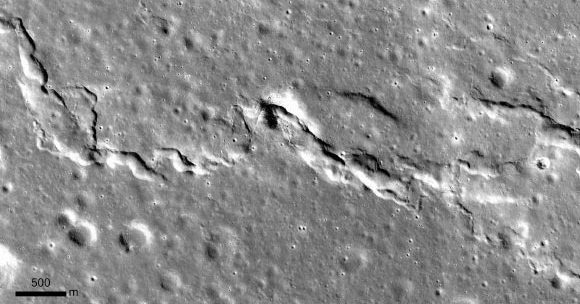
Recent studies reveal that the Moon is tectonically active, challenging the long-held view that its geology has been largely static for billions of years. While the Earth has a crust divided into moving plates that create mountains, ocean trenches, and volcanoes, the Moon lacks plate tectonics. Yet internal stresses in the lunar crust still generate distinctive landforms.
One of the most notable features are lobate scarps, which form when the crust compresses, pushing material over adjacent layers along faults to create ridges. Found mainly in the lunar highlands, these scarps have formed within the last billion years, representing the Moon’s most recent 20% of geological history.
In 2010, Tom Watters discovered that the Moon is gradually shrinking, and this contraction explained the formation of lobate scarps. However, not all recent contractional features could be accounted for by these scarps.
A new study has identified another type of tectonic landform: SMRs (Small Mare Ridges), which form through similar forces as lobate scarps but are found exclusively in the Moon’s maria, the darker volcanic plains.
In their research, Dr. Watters and his team mapped SMRs across the nearside maria and analyzed their link to recent lunar tectonic activity. Cole Nypaver noted that while lobate scarps have long been known in the highlands, this is the first time scientists have documented the widespread presence of comparable features throughout the maria.
The team compiled the first comprehensive catalog of SMRs, identifying 1,114 new segments, raising the total known SMRs on the Moon to 2,634. They determined that the average age of SMRs is 124 million years, similar to lobate scarps, which average 105 million years, indicating that both are among the Moon’s youngest geologic features.
Analysis shows that SMRs form along the same type of faults as lobate scarps, and in some cases, scarps in the highlands transition into SMRs in the maria, suggesting a shared origin. Together, these structures provide a more complete picture of contractional tectonic activity across the Moon.
“Our detection of young, small ridges in the maria and understanding their formation completes a global view of a dynamic, contracting Moon,” Dr. Watters said.
The findings were published in the Planetary Science Journal, offering new insights into the Moon’s interior, its thermal and seismic history, and the potential for future moonquakes.