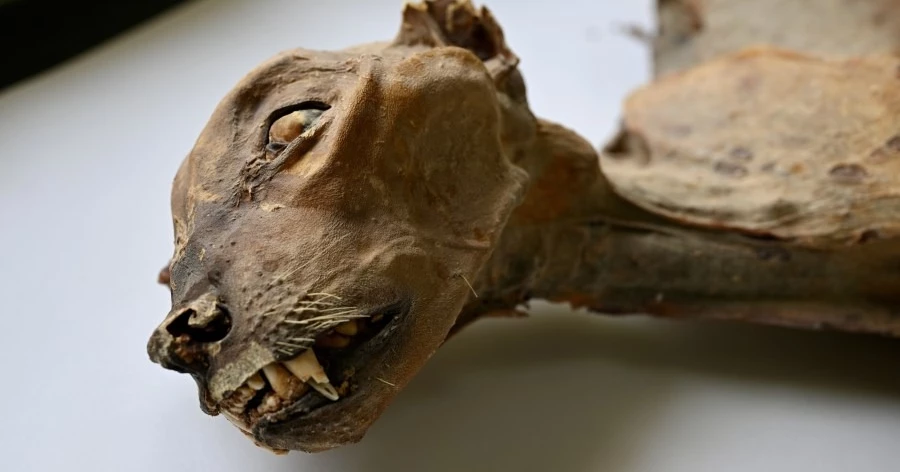
Scientists have discovered the mummified remains of cheetahs in caves near Arar in northern Saudi Arabia, shedding light on populations that disappeared from the region centuries ago.
The remains, dating from 130 to over 1,800 years old, include seven complete mummies and the bones of 54 additional cheetahs. Unlike typical decay, mummification preserves the body, and in this case, the caves’ dry conditions and stable temperatures likely contributed to the preservation. The cats’ shriveled limbs and cloudy eyes give them a “dried-out husk” appearance.
Researchers are uncertain why so many cheetahs were found in the caves. It may have been a denning site, where mothers gave birth and raised their young.
“These are large cat remains preserved in a way that is entirely without precedent,” said Ahmed Boug of the National Center for Wildlife in Saudi Arabia. Scientists note that for such preservation, carcasses must avoid scavengers like birds and hyenas, as well as the right environmental conditions.
Cheetahs once roamed across most of Africa and parts of Asia, including the Arabian Peninsula, but now occupy just 9% of their former range due to habitat loss, unregulated hunting, and declining prey.
For the first time with naturally mummified large cats, researchers could study DNA, showing that these cheetahs were genetically closest to modern Asian and northwest African cheetahs. This insight could guide efforts to reintroduce cheetahs to areas where they have long vanished.
The study was published Thursday in Communications Earth and Environment.