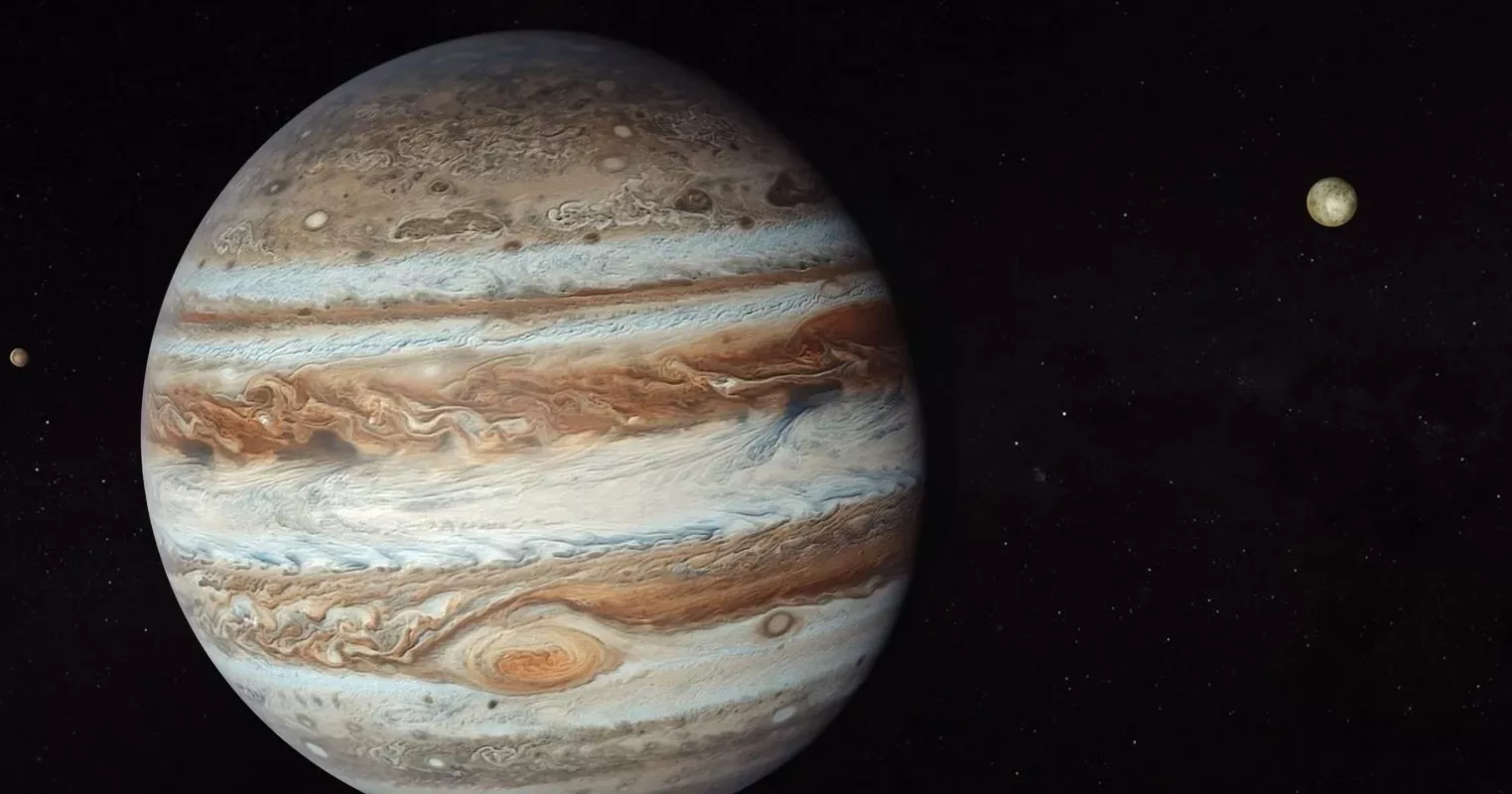
New findings from NASA’s Juno mission suggest that Jupiter, the largest planet in the solar system, is slightly smaller and more flattened than scientists previously believed.
According to NASA, researchers analysed radio occultation data collected during 13 close flybys of the gas giant, while also factoring in the impact of Jupiter’s powerful zonal winds. The study, published in the journal Nature Astronomy, found that Jupiter is around 8 kilometres narrower at the equator and about 24 kilometres flatter at the poles than earlier measurements indicated.
NASA explained that radio occultation allows scientists to peer through Jupiter’s thick and opaque cloud layers to gain insights into its internal structure. During these experiments, Juno sends radio signals to Earth-based receivers in NASA’s Deep Space Network. As the signals travel through Jupiter’s ionosphere, atmospheric gases bend and slow them.
NASA postpones crewed moon mission to March after hydrogen leaks
By analysing subtle changes in the frequency of these signals, scientists can calculate key atmospheric properties, including temperature, pressure and electron density at various depths within the planet’s atmosphere.
The agency said that determining Jupiter’s precise size and shape is crucial because the planet serves as an important reference point for studying giant exoplanets beyond the solar system. A more accurate model of Jupiter will help astronomers better interpret observations of distant planets as they transit their host stars.