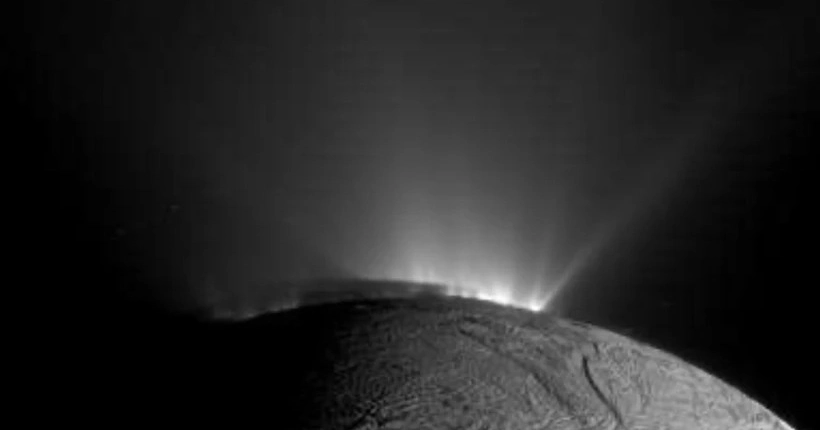
Scientists have discovered new organic compounds in icy plumes erupting from Saturn’s moon Enceladus, strengthening the case that the small ocean world may harbor conditions suitable for life.
The findings, published Wednesday in Nature Astronomy, are based on data collected by NASA’s Cassini spacecraft during a high-speed flyby of Enceladus in 2008. With a hidden subsurface ocean and jets of water and ice particles erupting from cracks near its south pole, Enceladus has long been considered a prime candidate in the search for life beyond Earth.
“Being habitable and being inhabited are two very different things,” said Fabian Klenner of the University of Washington, a member of the research team. “We believe Enceladus is habitable, but we do not know if life exists there.”
The research team analyzed tiny, relatively fresh ice grains from the geysers, which collided with Cassini’s cosmic dust analyzer at 40,000 mph (64,800 kph). These grains offered a clearer picture of the moon’s chemistry than older particles, which may have been altered over time by space radiation. While some previously identified organics were confirmed to originate from Enceladus’ subsurface ocean, new chemical compounds were also detected.
Enceladus, only 310 miles (500 kilometers) wide with a rocky core, is believed to host hydrothermal vents on its ocean floor, similar to those in Earth’s Arctic. Its water vapor and ice plumes extend thousands of kilometers into space.
“Nozair Khawaja, lead author from the Free University of Berlin, said, “We are confident these molecules come from Enceladus’ underground ocean, highlighting its potential to support life.”
Scientists advocate for future missions to further explore Enceladus. While Cassini ended its mission in 2017, both the European Space Agency and China are planning potential lander missions. Meanwhile, NASA’s Europa Clipper, set to begin orbiting Jupiter in 2030, will investigate Jupiter’s icy moon Europa, another ocean world, alongside ESA’s Juice mission.
“Underground oceans on moons may be the best locations for extraterrestrial life in our solar system,” said Nigel Mason, a physics professor at the University of Kent, who was not involved in the study. “These findings underscore the need for continued exploration.”
Source: AP