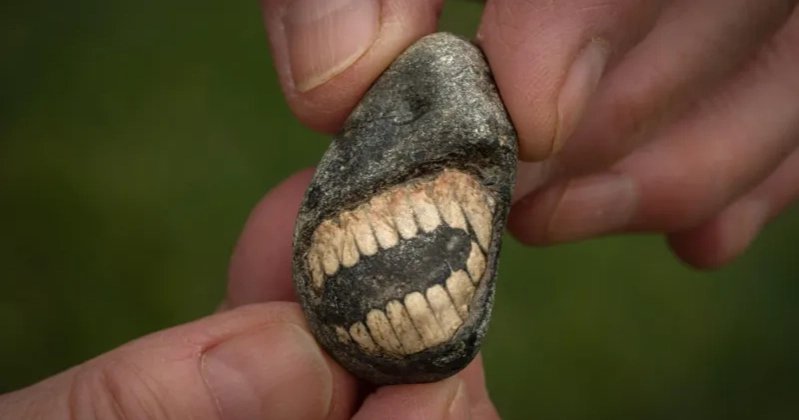
Christine Clark, 64, spotted the unusual find while walking along the beach on Boxing Day during a holiday in Northumberland. She said a small pebble caught her attention because it looked as if it was grinning back at her, resembling a set of false teeth.
Clark later shared photos of the object on a Facebook fossil identification group, where it quickly attracted thousands of reactions. Fellow enthusiasts suggested it was an ancient marine fossil, a view later supported by experts.
Clark, who visits the area every year with her husband Gerard, said they often search for “St Cuthbert’s beads” on the island. Holy Island, home to around 150 residents and regularly cut off by the sea, is regarded as the birthplace of early English Christianity.
The so-called beads are fossilised segments of the stem of a marine animal known as a crinoid. Their name is linked to St Cuthbert, the patron saint of northern England.
According to Dr Frances McIntosh, a collections curator at English Heritage, St Cuthbert arrived on the island as a monk in the 670s and was later buried there. In medieval times, people believed the small fossils were created by the saint and collected them for spiritual reasons.
While searching for these beads, Clark instead came across a very different fossil. Joking about the discovery, she said it was the first “set of teeth” she had ever found.
The fossil was examined with the help of BBC and identified by the British Geological Survey as a larger section of a crinoid stem.
Crinoids are marine animals that first appeared more than 500 million years ago and still exist today. They have a flexible stem attached to the sea floor, topped with a body surrounded by branching arms, which has earned them the nickname “sea lilies”.
Dr Jan Hennissen, a senior palaeontologist at the British Geological Survey, explained that the fossil consists of several disc-like segments, known as ossicles, still connected together in a structure called a columnal. The stem appears to have split lengthways and curved, creating its distinctive mouth-like shape. He said it likely came from the Alston Formation, a limestone dating back about 350 million years.
Crinoids belong to the same group of animals as sea urchins and sea cucumbers. Complete specimens are rare, but the individual stem discs are common along the Northumberland coast and are easily recognised by their colour, composition and distinctive lines.
Experts note that members of the public can have fossils identified by sending photographs to the British Geological Survey or the Natural History Museum identification service.
Although Clark has received offers to buy her find, she said she plans to keep it for now, adding that it has brought amusement to many people.
#With inputs from BBC