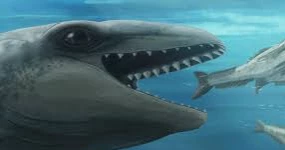
Paleontologists have identified a rare, previously unknown species of ancient whale after discovering a 25-million-year-old fossil on an Australian beach. The new species, named Janjucetus dullardi, sheds light on early whale evolution.
The juvenile fossil, small enough to fit in a single bed, had bulging eyes the size of tennis balls, a shark-like snout, and sharp teeth, suggesting it was a fierce predator despite its deceptively “cute” appearance, researchers said.
The partial skull, including ear bones and teeth, was uncovered in 2019 at Jan Juc Beach in Victoria, a hotspot for studying early whales. Janjucetus dullardi belongs to the mammalodontid group of early whales from the Oligocene Epoch (34–23 million years ago) and is only the fourth species identified in this group.
Experts abandon hope for 157 stranded false killer whales in Australia
Amateur fossil hunter Ross Dullard discovered the skull and had been searching the site for years. The find, the first mammalodontid identified in Australia since 2006, provides valuable insight into how prehistoric whales lived and evolved.
Researchers said such discoveries could help understand ancient cetaceans’ adaptations to warmer oceans and inform studies on modern marine life amid climate change.
Source: Agency