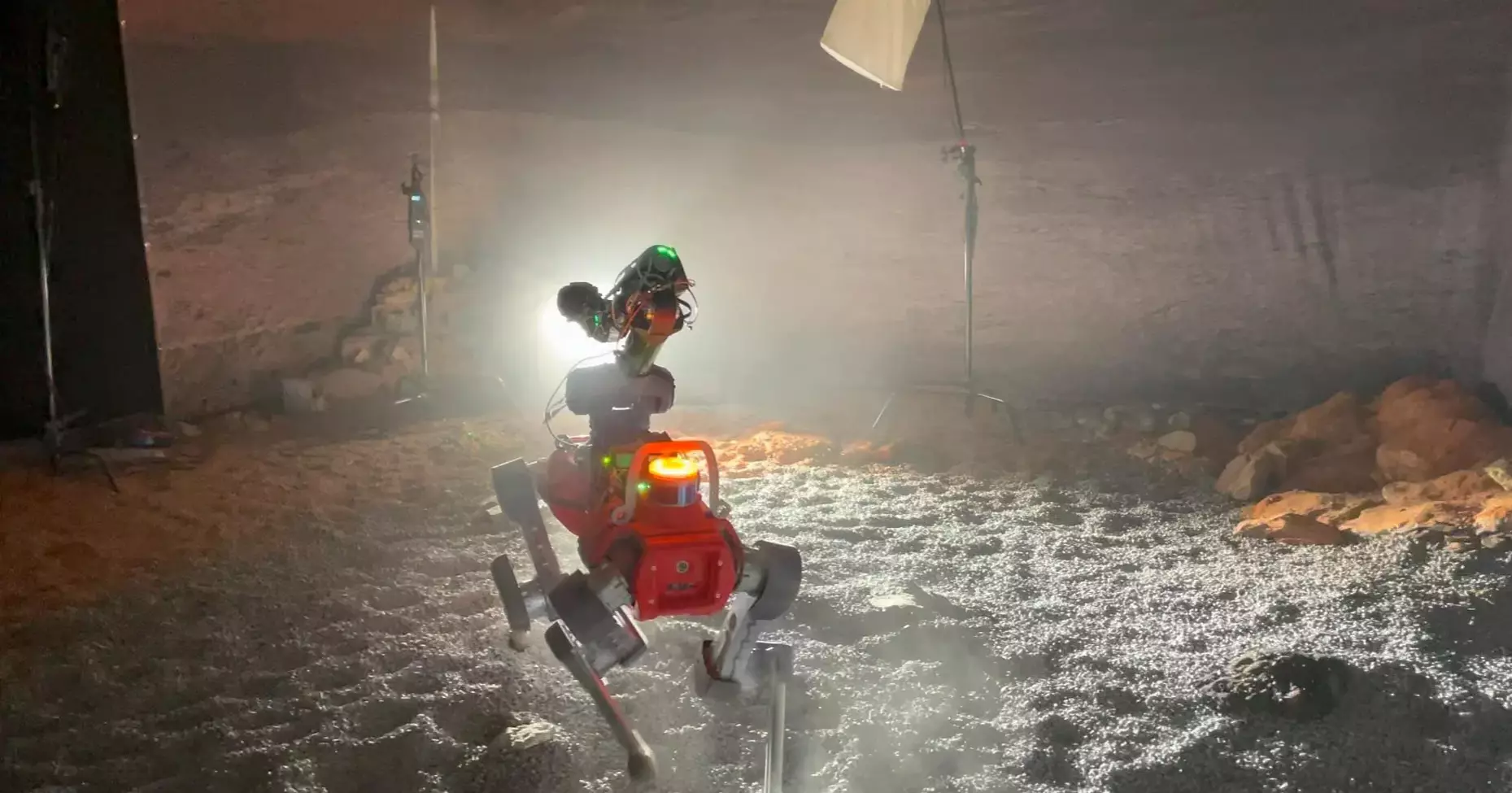
A new walking robot could change the way scientists explore Mars, helping them study more rocks faster and uncover clues to life and resources in record time.
Mars missions face serious challenges. Communication delays between Earth and robotic explorers can range from four to 22 minutes, and limited data capacity means every move must be carefully planned. Rovers also travel slowly to save energy and avoid hazards, usually covering just a few hundred meters a day. This slows down research and limits the variety of geological data collected.
To tackle these limits, researchers tested a semi-autonomous robot that can move from one target to another and collect data on its own. Equipped with compact instruments, the robot can examine multiple rocks in sequence, perform measurements independently, and send results back to scientists.
The tests showed significant gains in efficiency. Instead of focusing on a single rock under constant supervision, the robot could analyze several locations on its own, accelerating both the search for resources and signs of life, or “biosignatures.” Even with simpler instruments, the robot successfully identified rocks important for astrobiology and resource exploration.
The experiments used the four-legged robot ‘ANYmal’, equipped with a robotic arm holding a microscopic imager and a portable Raman spectrometer developed for the ESA-ESRIC Space Resources Challenge. The tests were conducted at the Mars-like “Marslabor” facility at the University of Basel, which simulates planetary surfaces with analogue rocks, dust, and lighting.
During trials, ANYmal autonomously approached selected targets, positioned its instruments, and transmitted images and spectral data. It successfully identified a variety of rocks, including gypsum, carbonates, basalts, dunite, and anorthosite—materials valuable for both science and future missions. Multi-target missions took 12–23 minutes, compared to 41 minutes for traditional human-guided exploration, without compromising accuracy.
This approach could allow future Mars and Moon missions to scan larger areas in less time. Semi-autonomous robots could move more freely, analyze samples quickly, and provide scientists with data to decide which sites deserve closer study. Smaller, simpler instruments paired with agile robots may become a key tool in space exploration, improving both the hunt for resources and the search for past life.