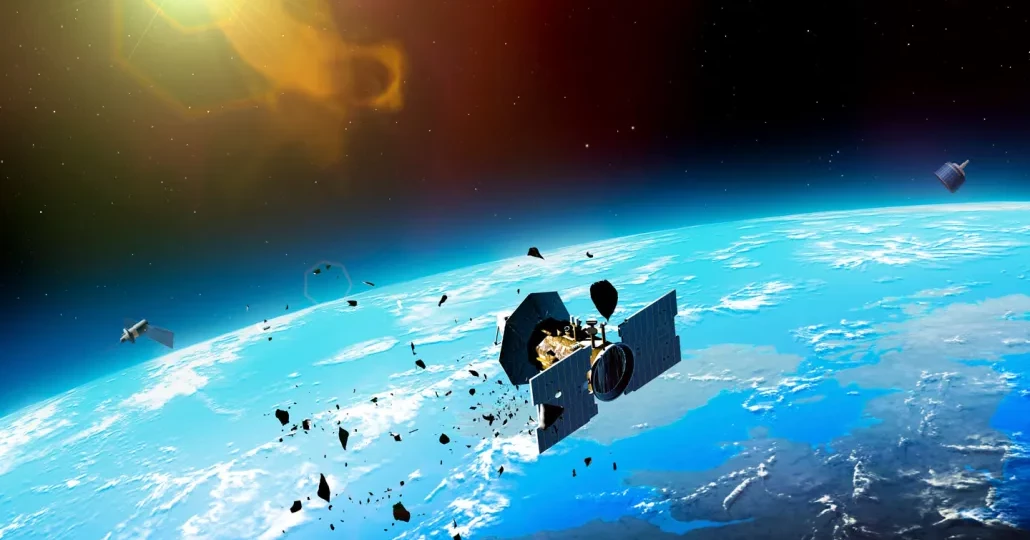
Increasing solar activity, marked by rising sunspot numbers, is causing space debris in low Earth orbit to lose altitude and fall back toward Earth more quickly, according to new research.
The study, published on May 6 in Frontiers in Astronomy and Space Sciences, found that satellites and debris in low Earth orbit are more rapidly pulled downward when the Sun reaches its active phase in its roughly 11-year cycle.
Researchers say the finding could help improve space mission planning at a time when growing amounts of orbital debris are increasing the risk of collisions with operational satellites and spacecraft.
The research team, led by astrophysicist Ayisha Ashruf from the Vikram Sarabhai Space Centre, tracked 17 pieces of space debris over more than 30 years to study how solar activity affects their movement.
They identified a clear threshold: when sunspot numbers reached about 70 percent of their peak, orbital decay began to increase significantly.
Scientists have long suspected a link between solar activity and space debris movement, but this study is the first to clearly demonstrate the relationship over multiple solar cycles.
The Sun’s activity rises and falls in an approximately 11-year cycle. At its peak, sunspots become more numerous and solar radiation intensifies. This heats and expands Earth’s upper atmosphere, known as the thermosphere, increasing atmospheric drag on objects in low orbit.
Objects in low Earth orbit, located roughly 160 to 2,000 kilometres above Earth, are forced to move through this denser atmosphere, slowing them down and gradually lowering their altitude.
The study found that during three consecutive solar cycles between 1986 and 2024, the tracked debris — orbiting at altitudes of around 600 to 800 kilometres — consistently dropped a few kilometres whenever solar activity crossed the identified threshold.
Researchers also noted that the extent of orbital decay varied depending on the intensity of each solar cycle.
The findings could help space agencies better predict orbital conditions and plan satellite launches to reduce collision risks, especially as space debris continues to accumulate around Earth.
#From Sciencenews.org