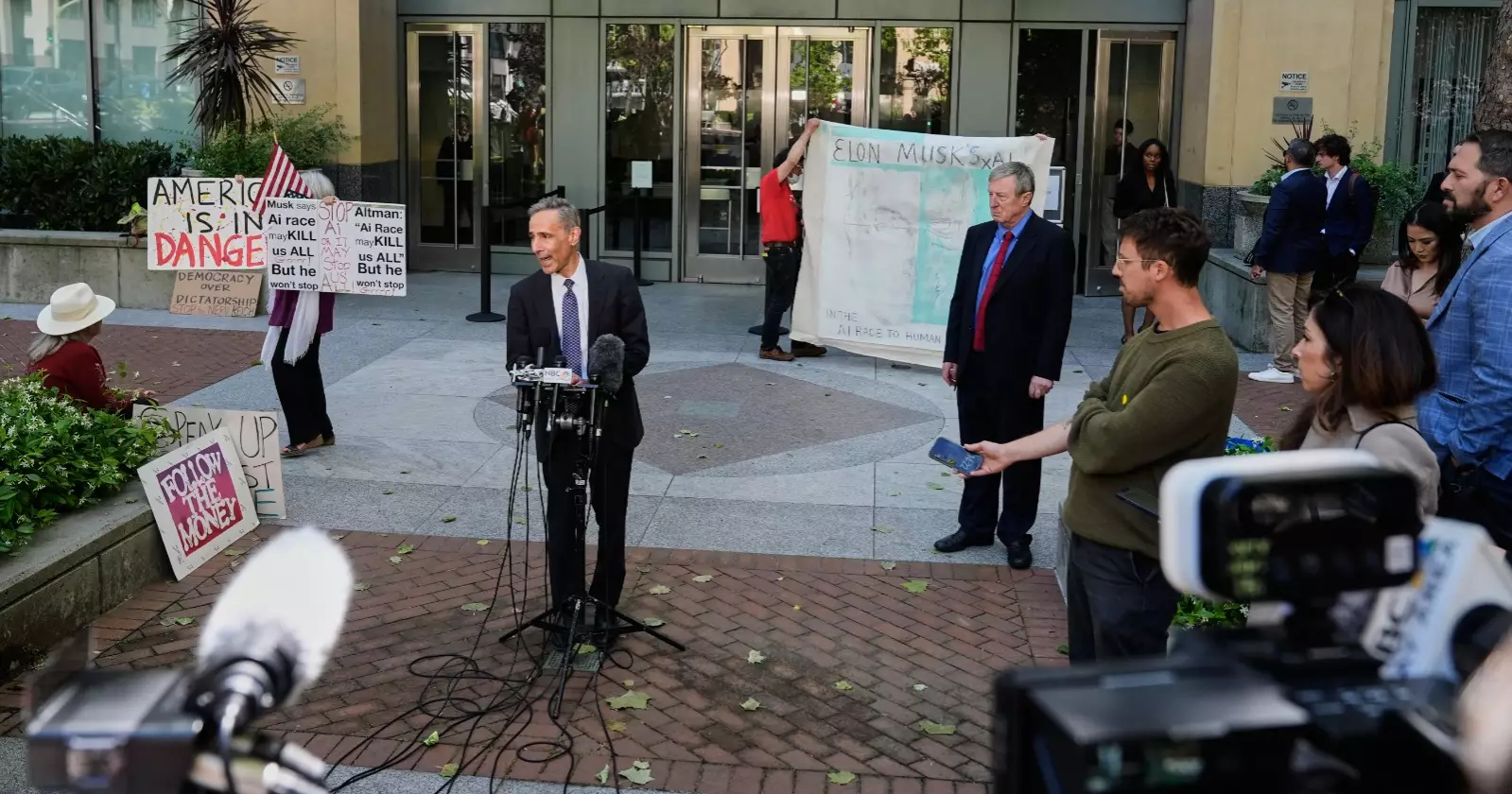
Concerns over the risks posed by artificial intelligence have emerged as a major theme in the ongoing courtroom battle between billionaire Elon Musk and Sam Altman, even though the technology itself is not formally on trial.
The federal trial in Oakland, California, centres on Musk’s lawsuit accusing Altman and fellow OpenAI leaders of abandoning the organisation’s original nonprofit mission.
Musk claims the company betrayed its founding promise to develop artificial intelligence for the benefit of humanity rather than private profit. OpenAI, however, argues that Musk is attempting to slow down the company to help his own AI venture, xAI.
Although Judge Yvonne Gonzalez Rogers warned lawyers not to turn the case into a debate over AI safety, discussions about the technology’s dangers have repeatedly surfaced during testimony.
Witnesses and lawyers have raised concerns ranging from job losses and misinformation to discrimination and emotional dependency on AI chatbots. Some testimony also touched on Musk’s long-standing warnings that highly advanced AI could eventually threaten humanity itself.
AI researcher Stuart Russell testified as an expert witness for Musk’s legal team, saying the intense competition among companies to dominate artificial intelligence could itself pose risks.
Russell, a computer scientist at the University of California, Berkeley, told the court that whichever company first develops artificial general intelligence (AGI) could gain enormous power over competitors.
He listed several concerns linked to AI, including racial and gender bias, job displacement, misinformation and psychological harm to some chatbot users.
“Whichever company develops AGI first would have a very big advantage,” Russell told jurors.
The trial focuses on the founding of OpenAI in 2015 as a nonprofit research organisation backed in part by Musk.
Both Musk and Altman have publicly stated that OpenAI was created to safely develop advanced AI for humanity’s benefit, though each side now accuses the other of trying to gain control over the technology.
A nine-member jury from the San Francisco Bay Area will decide whose claims are more credible.
Before testimony began, Judge Gonzalez Rogers cautioned lawyers against broad discussions about whether AI is harmful to humanity.
“This is not a trial on the safety risks of artificial intelligence. This is not a trial on whether or not AI has damaged humanity,” the judge said.
Despite that warning, Musk used part of his testimony last week to discuss his concerns about the future of AI.
He described AGI as a stage where AI becomes “as smart as any human” and claimed society is approaching that point rapidly.
“We are getting close to that point,” Musk said, adding that AI could surpass human intelligence as early as next year.
Musk said he had long viewed AI as “a double-edged sword” and was worried about the concentration of power within major technology firms such as Google.
According to Musk, one of the reasons for helping establish OpenAI was to create a counterbalance to Google’s dominance in AI development.
During testimony, Musk also said he intentionally helped create OpenAI as a nonprofit organisation rather than a profit-driven company.
“I deliberately chose this for the public good,” he said.
The judge questioned that argument, noting that Musk later launched his own AI company, xAI, which now operates in the same field.
OpenAI co-founder and president Greg Brockman defended the organisation’s mission during his testimony this week.
Brockman said OpenAI’s work was always intended to serve humanity rather than any single corporation or individual.
“It was about humanity as a whole,” he said.
He also claimed Musk sought personal control over the company in its early days.
According to Brockman, Musk initially appeared supportive of Altman becoming OpenAI’s chief executive but later insisted people needed to know “he was in charge.”
Musk is seeking damages in the case and also wants Altman removed from OpenAI’s board. Legal experts say a victory for Musk could complicate OpenAI’s plans for a future stock market listing.