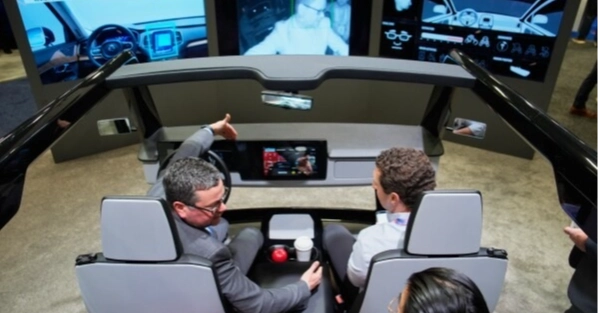
At CES in Las Vegas, automakers and tech companies showcased a vision of cars as more than machines—vehicles that can act as proactive companions, adapting to drivers and passengers in real time.
One example presented by Nvidia’s Sri Subramanian illustrated a car recognizing a child entering the back seat, knowing it’s her birthday, and playing her favorite song automatically. “Think of the car as having a soul and being an extension of your family,” Subramanian said. His demonstration highlighted the increasing sophistication of AI systems inside cars and the expanding use of personal data to enhance the driving experience.
Read More: Musk’s Grok chatbot faces global backlash over sexualized AI images
Exhibits across the show emphasized cars’ ability to monitor occupants’ emotions, heart rates, and safety—for instance, alerting if a child is accidentally left behind. Bosch unveiled an AI-powered system aimed at making the cabin a “proactive companion,” while Nvidia introduced Alpamayo, designed to help autonomous vehicles make complex driving decisions. CEO Jensen Huang called it a “ChatGPT moment for physical AI.”
However, experts cautioned that this personalization raises concerns about data privacy. Justin Brookman of Consumer Reports noted that, unlike smartphones, cars are only recently becoming major repositories of personal information. Cameras, microphones, and sensors inside vehicles can feel intrusive, especially since cars are often seen as extensions of personal space. “People generally want more privacy but don’t always know how to protect it,” he said.
Read More: Japan turns to new technology as dementia cases surge
Despite privacy concerns, these AI systems offer potential safety benefits. Automotive supplier Gentex demonstrated a mock six-seater van equipped with AI sensors capable of detecting whether drivers or passengers are drowsy, improperly seated, eating, or distracted. Brian Brackenbury of Gentex said the data is processed and stored within the car, then deleted after use. “We’re not going to collect data just because we can,” he added. “Data privacy is really important.”
The CES showcase reflects a broader trend toward smarter, more interactive vehicles that promise convenience and safety, while also prompting new debates about how personal data should be managed in cars.