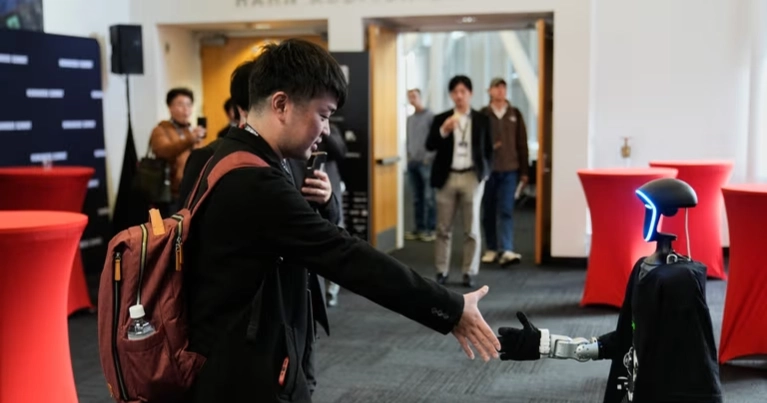
Humanoid robots took center stage at a major Silicon Valley gathering this week as advances in artificial intelligence renewed investor interest, though doubts remain about how soon humanlike machines will become a practical reality.
More than 2,000 people, including engineers from Disney, Google and dozens of startups, attended the Humanoids Summit to showcase emerging technology and debate how to speed up development of robots designed to move and work like humans. Summit founder Modar Alaoui said many researchers now see humanoids or other physical forms of AI as inevitable, with the main uncertainty being how long it will take.
The recent boom in AI, fueled by systems such as ChatGPT and Google’s Gemini, has injected fresh momentum into a field long considered too complex and expensive for investors. Supporters argue that the same breakthroughs that improved language-based AI are also helping robots better understand their surroundings and perform tasks using vision and language models.
Disney highlighted its progress with a walking robotic version of the “Frozen” character Olaf, which is expected to roam independently in Disneyland parks in Hong Kong and Paris early next year. While such entertainment-focused machines already exist, experts said truly general-purpose robots capable of contributing meaningfully in homes or workplaces are still years away.
Skepticism was evident even among conference participants. Cosima du Pasquier, co-founder of Haptica Robotics, said the humanoid sector still faces major scientific and engineering hurdles, noting that much research remains unresolved.
According to consultancy McKinsey, around 50 companies worldwide have raised at least $100 million to develop humanoid robots, with China leading the race. Government incentives, a push to build a full humanoid ecosystem by 2025 and strong manufacturing capacity have given Chinese firms an edge, reflected in their dominance at the summit’s exhibition area.
In contrast, U.S. efforts have been driven largely by private investment and excitement around AI. High-profile skeptics remain, including robotics pioneer Rodney Brooks, who has argued that current humanoids are unlikely to achieve true dexterity despite massive funding.
Some practical deployments are already under way. Agility Robotics recently announced that its warehouse robot Digit is being tested at a Texas distribution center run by Mercado Libre, showing how robots with limited humanlike features are entering workplaces.
Industry leaders said competition between countries is intensifying. Jeff Burnstein, head of the Association for Advancing Automation, said the United States has strong AI expertise but acknowledged that China currently has greater momentum in humanoid development, leaving the question of global leadership still open.