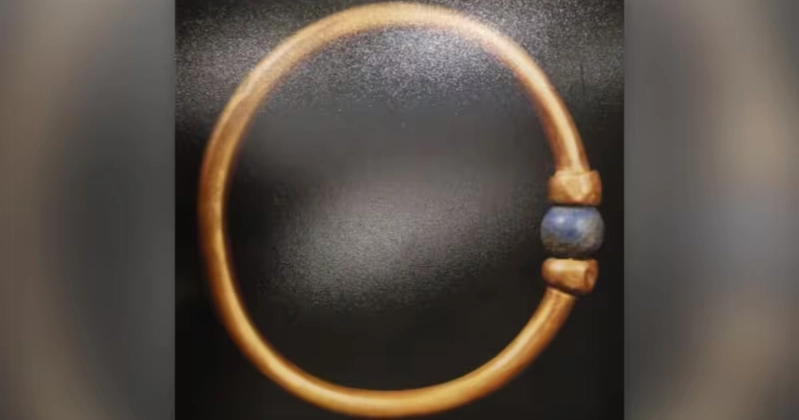
Egyptians expressed anger this week after officials confirmed that a 3,000-year-old bracelet once owned by Pharaoh Amenemope was stolen from Cairo’s Egyptian Museum and later melted down for gold.
Tourism and Antiquities Minister Sherif Fathy said in televised remarks Saturday night that the theft occurred on Sept. 9 while staff were preparing artifacts for an exhibition in Italy. He blamed “lax procedures” at the museum and noted that prosecutors are investigating the case.
The bracelet, which featured a lapis lazuli bead, was stolen from a restoration lab at the museum. Authorities said it passed through several dealers before being sold for roughly $4,000 and ultimately melted into jewelry. The minister also acknowledged the lab had no security cameras.
Four people have been arrested, including a restoration specialist at the museum who admitted to handing the bracelet to a friend who owned a silver shop in Cairo’s Sayyeda Zainab district. It was then sold on to a gold workshop owner before being resold and melted down by another worker. Officials said the suspects confessed, and the money from the sale has been seized.
The ministry released security footage showing a shop owner weighing the bracelet and paying one of the suspects. On Sunday, local media reported that a judge extended the detention of the restoration specialist and her associate for 15 more days, while granting bail of 10,000 Egyptian pounds ($207) each to the two others.
The destruction of the relic, which had survived for three millennia, sparked widespread grief in Egypt, where ancient heritage is deeply cherished. Critics also questioned museum security and demanded stricter safeguards for the nation’s treasures.
Prominent archaeologist Monica Hanna urged a halt to overseas exhibitions “until better control” is ensured. Human rights lawyer Malek Adly described the incident as “an alarm bell,” calling for stronger protection of antiquities both on display and in storage.
Pharaoh Amenemope ruled from Tanis in the Nile Delta during Egypt’s 21st Dynasty. His royal necropolis, discovered in 1940 by French archaeologist Pierre Montet, includes about 2,500 artifacts such as golden masks, silver coffins, and jewels, many restored in 2021 with support from the Louvre Museum.
The theft also revived memories of previous cultural losses, including the disappearance of Vincent van Gogh’s Poppy Flowers painting from a Cairo museum in 2010. The artwork, valued then at $50 million, was stolen once before in 1977 but later recovered. It has not been found since the 2010 theft.