
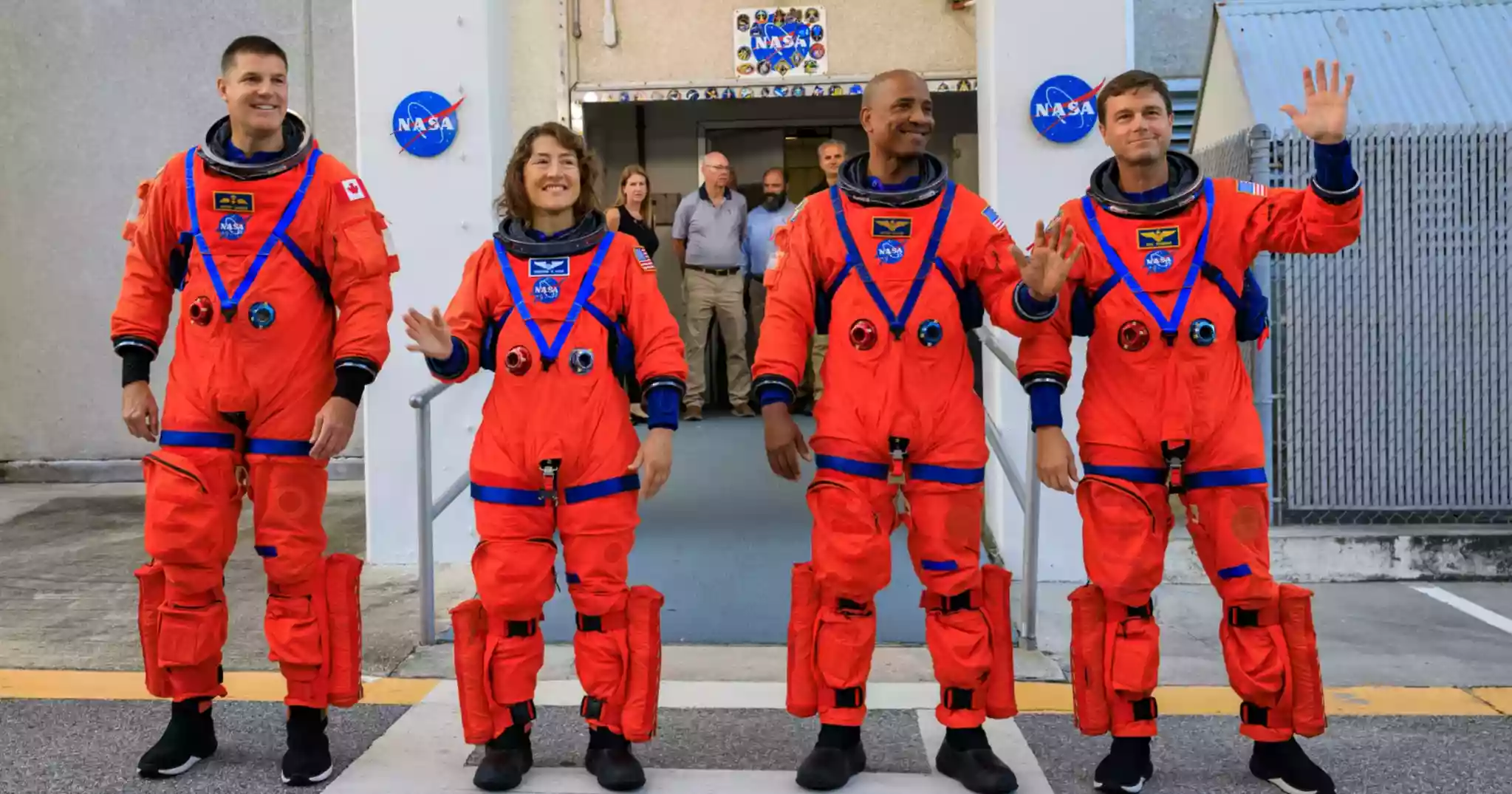
The astronauts aboard Artemis II are blazing a trail in the new era of lunar exploration. Following last week’s launch—the first manned lunar mission since 1972—the crew of three Americans and one Canadian is preparing to surpass Apollo 13’s record for the farthest distance humans have traveled from Earth.
On Monday, they will swing around the moon on a flyby without landing, then begin their return journey home.
The roughly six-hour lunar flyby will offer unprecedented views of the moon’s far side, previously difficult or impossible for the 24 Apollo astronauts to observe. Additionally, the astronauts will witness a total solar eclipse, with the moon obscuring the sun and revealing glimpses of its luminous corona.
“We’ll get eyes on the moon, kind of map it out and then continue to go back in force,” said flight director Judd Frieling, emphasizing NASA’s long-term goal of establishing a lunar base equipped with landers, rovers, drones, and habitats. This mission offers a close-up look at Earth’s constant companion, taking lunar exploration to new heights.
Apollo 13: The Previous Record Holder for Lunar Distance
In 1970, Apollo 13’s astronauts—Commander Jim Lovell, Fred Haise, and Jack Swigert—never made it to the moon due to an oxygen tank rupture. With their lives in peril, Mission Control rerouted the spacecraft onto a free-return trajectory, using the combined gravity of the Earth and moon to safely guide them home with minimal fuel. The mission, famously dubbed NASA’s greatest “successful failure,” became a testament to ingenuity and survival under pressure. (Contrary to popular belief, the iconic line “Failure is not an option” originated from the 1995 Tom Hanks film, not the actual mission.)
Apollo 13 set a record for human distance from Earth at 248,655 miles (400,171 kilometers). Artemis II aims to exceed this by over 4,100 miles (6,600 kilometers) as its crew follows a similar figure-eight path without orbiting or landing on the moon. Christina Koch, one of the astronauts, described the milestone as more than a number—“an important achievement that people can understand and wrap their heads around,” connecting past accomplishments with future lunar exploration.
Artemis II Crew Takes Shifts for Prime Lunar Photography
During the flyby, the crew will split into pairs to capture detailed lunar images from their windows. At closest approach, they will come within 4,070 miles (6,550 kilometers) of the moon. While the April 1 launch date means less illumination of the far side than other windows might provide, astronauts will still see previously unobserved lunar features, including significant portions of the Orientale Basin.
Each astronaut will use both professional-grade cameras and personal devices like iPhones for spontaneous shots. NASA geologist Kelsey Young prepared lunar geography flashcards to help the crew recognize key features. “They’ve practiced for many, many months on visualizations of the moon,” Young said. “Getting their eyes on the real thing will bring the moon a little closer to home for all of us.”
Total Solar Eclipse Adds a Rare Celestial Bonus
The timing of the Artemis II mission also coincides with a total solar eclipse visible only from space. The astronauts will have a few minutes to observe the sun’s corona—the outermost layer of its atmosphere—while monitoring for any unusual solar activity. Each crew member brought eclipse glasses to protect their eyes during the brief but spectacular event.
Communication Blackout Behind the Moon
Like Apollo missions before them, Artemis II will experience a nearly hour-long communication blackout when the Orion capsule passes behind the moon. NASA’s Deep Space Network antennas in California, Spain, and Australia won’t have line-of-sight contact, leaving the crew temporarily out of touch. Frieling reassured that physics will guide the spacecraft safely back into communication range, just as it did for Apollo missions decades ago.
Returning to Earth: Artemis II’s Homeward Journey
After departing the lunar vicinity, Artemis II will take four days to return to Earth, aiming for a Pacific Ocean splashdown near San Diego on April 10, nine days after the Florida launch. On the way back, the astronauts will connect via radio with the crew aboard the International Space Station, marking the first time a moon-bound crew has had colleagues in orbit simultaneously. The discussion will feature two pioneers of NASA’s first all-female spacewalk in 2019: Christina Koch aboard Orion and Jessica Meir on the station.
Artemis II not only bridges past and present lunar exploration but also sets the stage for the next generation of human missions beyond Earth