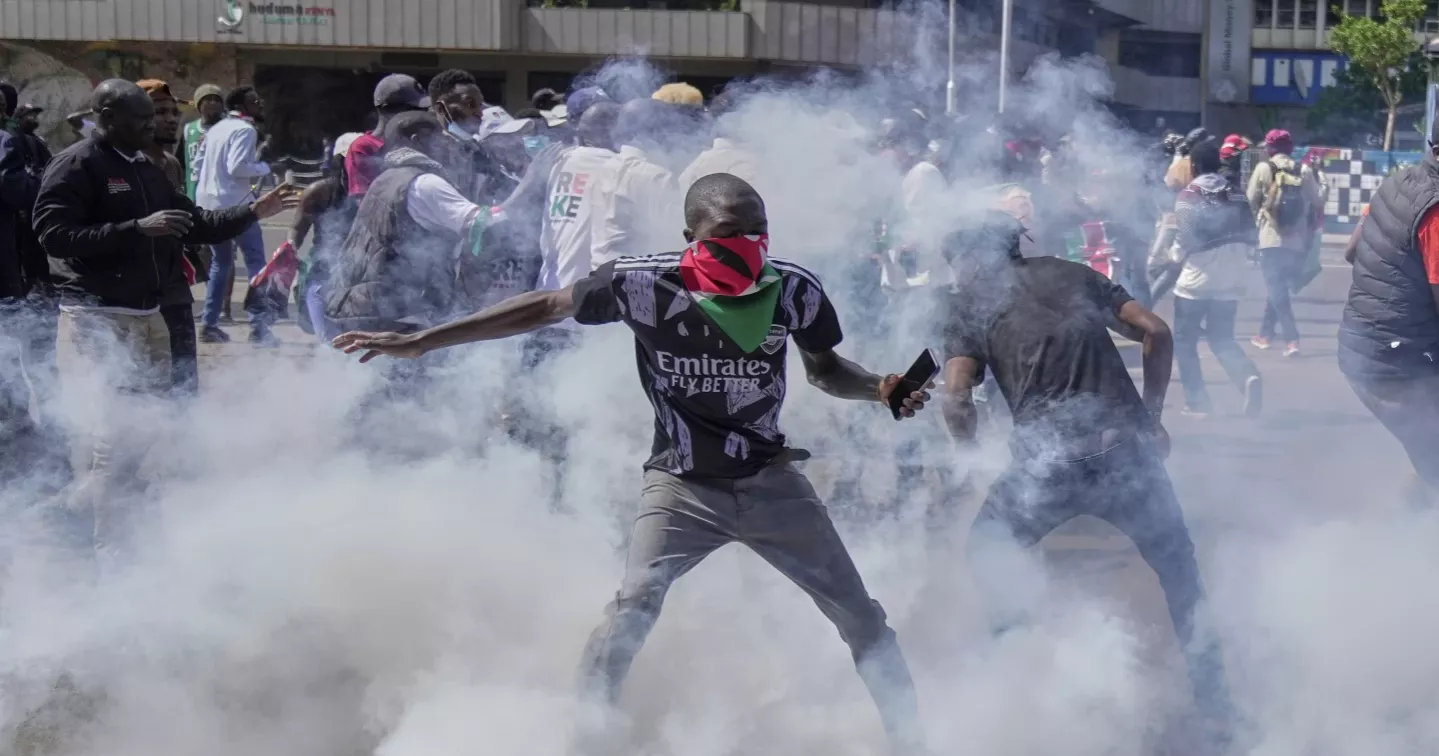
At least eight people have died and over 80 others are receiving specialized treatment, some with gunshot wounds, following nationwide protests in Kenya against police brutality and poor governance, according to human rights organizations.
The Kenya National Commission on Human Rights, a state-funded body, reported that Wednesday’s demonstrations, which took place across 23 of Kenya’s 47 counties, resulted in over 400 injuries and more than 60 arrests.
The protests were held to mark one year since anti-tax demonstrations left at least 60 people dead and 20 others missing.
In the capital, Nairobi, access to Parliament and the president’s office was blocked with razor wire and road barricades as thousands of protesters confronted police, who responded with tear gas, live rounds, and batons, leaving several people injured.
The demonstrations quickly escalated, spreading to major cities such as Mombasa, Kisumu, Nakuru, and Nyahururu, with calls for President William Ruto to resign over allegations of mismanagement.
Last year’s anti-tax protests saw demonstrators storm Parliament, where tax hikes had been passed, setting parts of the building on fire as lawmakers fled. Witnesses and rights groups reported that police opened fire, leaving bodies in the streets, prompting the deployment of the military.
Frustration among young Kenyans has grown due to alleged government corruption, the rising cost of living, police violence, and the recent death of a blogger while in custody. Public outrage intensified further after a protester was shot at close range during recent demonstrations.
President Ruto, speaking at a funeral in coastal Kenya on Wednesday as protests intensified in Nairobi, called for calm, saying, “We do not have another country to go to. It is our responsibility to safeguard our nation.”
Youth-led protests erupt again in Kenya over police brutality and poor governance
Despite government efforts to downplay the protests, including statements by government spokesperson Isaac Mwaura calling Wednesday a “normal working day,” businesses in central Nairobi largely remained shut. Police restricted vehicle movement, while hundreds of protesters took to the streets early, chanting anti-government slogans as officers fired tear gas.
An Associated Press reporter witnessed one demonstrator suffer a mouth injury from police gunfire, while another protester was beaten over the head by anti-riot police and taken away by ambulance.
Wangechi Kahuria, executive director of the Independent Medico-Legal Unit, which monitors protest-related deaths, said citizens should be allowed to mourn peacefully.
Police Inspector General Douglas Kanja warned on Tuesday that unauthorized individuals would be barred from entering protected areas like Parliament and the State House.
Protester Rose Murugi accused police of contributing to the crisis, declaring, "We will say it boldly—police brutality must end, and Ruto must go.” Another demonstrator, 25-year-old Derrick Mwangi, said young people were "fed up" with the current state of affairs, citing abductions, killings, and increasing police violence.
Local media on Wednesday published the names and photos of some of those killed in last year’s protests. The Standard newspaper headlined its coverage with “A luta Continua,” Portuguese for “The struggle continues,” a phrase linked to Mozambique’s fight for independence.
Meanwhile, the Communication Authority banned live coverage of the protests and disrupted some free-to-air TV broadcasts, drawing condemnation from human rights defenders.
Political commentator Herman Manyora described the demonstrators as “heroes” who deserve recognition for their sacrifices. He called on the authorities to work with protesters to ensure a meaningful commemoration.
However, Manyora also noted that government inaction has fueled discontent, hardening the resolve of young people to continue their demonstrations.
Following last year’s protests, President Ruto dissolved the Cabinet amid allegations of corruption and incompetence, though many former ministers were reappointed. A controversial finance bill proposing higher taxes was initially withdrawn but new taxes were later introduced through amendments.
Protesters in Kenya’s Nairobi demand justice for blogger’s death in police custody
The president also brought opposition members into the Cabinet and, in March, signed a political agreement with opposition leader Raila Odinga, his main rival in the last election.
#Source: With input from agency