While the battles, victories, and political shifts of World War II are well-documented, the deepest wounds often remain unspoken.
Beneath the grand narratives lie the silent sufferings of millions—displaced families, destroyed communities, shattered childhoods, and lifelong trauma carried by survivors.
This is the untold story of pain that never made it into textbooks—the emotional and human cost of the most devastating war in modern history.
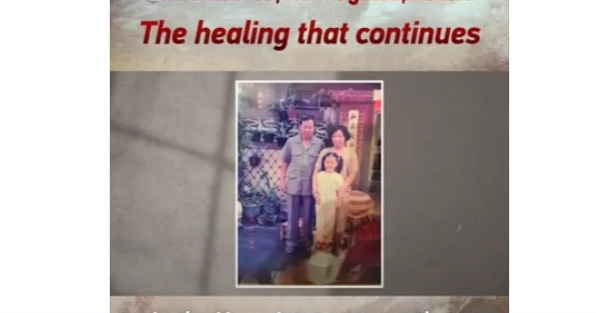
Liu Yuanyuan, a doctor from China’s Taiwan region who has lived on the mainland for over a decade, carries with her more than a medical mission — she carries a legacy. Her grandfather, a former Kuomintang soldier who survived the War of Resistance against Japanese aggression, left behind more than stories. He passed on the silent trauma of a generation shaped by war, displacement, and separation.
Unarmed and alone, Yuanyuan’s grandfather once survived by hiding in trees and eating bark and leaves when food ran out. After the war, China’s civil conflict swept him to Taiwan, tearing him away from his parents in Shandong Province. For decades, he held onto a waistband his mother had sewn for him — a simple piece of cloth that became a symbol of longing, memory, and unspoken pain.
Though he often told his war stories with humor, masking the hardship, his family always felt the weight behind his words. His wounds never fully healed — but through her work as a doctor, Yuanyuan now tries to heal others, bridging not just bodies, but communities. Her life stands as a quiet answer to the unresolved traumas of the past.
Yuanyuan’s story forms part of a wider mosaic of World War II memory. British vlogger Jack Forsdike shares how his grandfather bombed Nazi Germany. Russian artist Marina Nechaeva recounts how her great-great-grandmother survived the Siege of Leningrad. These stories span different geographies and scars, but are united by a shared struggle against fascism — and a shared inheritance of resilience.
What sets Yuanyuan’s story apart is its open-endedness. For Jack and Marina, their ancestors’ traumas were tied to specific wartime events. But for Yuanyuan’s grandfather, suffering extended far beyond 1945 — through exile, fractured family ties, and decades of silence. His story reminds us that for many Chinese families, the war did not end with victory, but with the long, slow pain of separation.
Today, Yuanyuan’s generation still lives in the shadow of that legacy. Her identity, career, and even her presence on social media reflect a desire to mend what was broken — to connect across the Taiwan Strait and help shape a future rooted in empathy and understanding.
This is not a story of despair, but one of endurance. It reminds us that the choices we make today — to heal, to connect, to remember — are shaped by those who came before. And in honoring their memory, we keep their stories alive, lighting the way forward through history’s lingering shadows.