
For the second consecutive day, China on Tuesday carried out joint live-fire military exercises around Taiwan, deploying air, naval, and missile forces in what Beijing described as a “strong warning” to pro-independence groups and what it called foreign interference. Taiwan responded by placing its military on heightened alert and accused China of being “the greatest threat to regional peace.”
Taiwanese aviation officials said the drills disrupted air traffic, affecting more than 100,000 international passengers because of flight cancellations and rerouting.
The exercises, named “Justice Mission 2025,” followed China’s anger over a potential record-breaking U.S. weapons sale to Taiwan and comments by Japanese Prime Minister Sanae Takaichi suggesting Japan’s military might become involved if China moved against the island. Beijing insists Taiwan is part of China and must eventually be unified.
Although China’s military did not directly mention the United States or Japan in its initial statement, the foreign ministry accused Taiwan’s ruling party of pushing independence by relying on U.S. backing. On Tuesday, China’s state-run Xinhua News Agency quoted a government spokesperson saying such efforts were “destined to fail.”
Zhang Xiaogang, a spokesperson for China’s Defense Ministry, urged other countries to abandon what he called the illusion of using Taiwan to restrain China and warned against challenging Beijing’s determination to protect its core interests.
Taiwan’s Defense Ministry said it had launched rapid-response drills and placed forces on high readiness, stating that the Chinese Communist Party’s actions once again demonstrated its aggressive nature and role in destabilizing peace.
U.S. President Donald Trump said he had not been informed ahead of time about the exercises but expressed little concern, noting that China has conducted naval drills in the region for decades. He emphasized his “strong relationship” with Chinese President Xi Jinping and said he did not believe Xi intended to attack Taiwan.
Military pressure intensifies
China regularly sends military aircraft and ships near Taiwan, and the scale and intensity of such operations have grown in recent years.
Senior Col. Shi Yi, spokesperson for the People’s Liberation Army’s Eastern Theater Command, said the drills were taking place in the Taiwan Strait and in surrounding waters to the north, south, east, and west of the island. He said the exercises focused on combat readiness patrols, gaining overall control in joint operations, and simulating blockades of key ports.
For the first time in a major drill, China openly stated that one objective was “full-spectrum deterrence beyond the island chain.” Shi described the operation as a necessary and legitimate measure to defend China’s sovereignty and national unity.
China and Taiwan have been governed separately since 1949, when Communist forces won China’s civil war and Nationalist troops retreated to Taiwan. Although Taiwan has operated with its own government ever since, Beijing continues to claim it as Chinese territory.
Testing military capabilities
On Monday, China deployed destroyers, frigates, fighter jets, bombers, drones, and long-range rocket systems in and around the Taiwan Strait. Live-fire drills targeted areas at sea, while training exercises tested coordination between air and naval forces and precision strike capabilities east of the strait.
According to Hsieh Jih-sheng, Taiwan’s deputy chief of general staff for intelligence, by mid-afternoon Monday, 89 Chinese aircraft and drones were operating nearby, with 67 entering Taiwan’s monitored response zone. Taiwan also detected 14 Chinese naval vessels in the strait, four warships in the western Pacific, and 14 coast guard ships.
Hsieh warned that the live-fire drills not only increased military pressure on Taiwan but also posed broader risks to neighboring countries and the international community.
China notified aviation authorities that seven temporary danger zones would be established for rocket launches from 8 a.m. to 6 p.m., restricting airspace access. Taiwan said more than 850 international flights and over 80 domestic flights were affected, disrupting travel for more than 106,000 passengers.
Airlines announced widespread delays and cancellations, particularly on routes serving islands close to China.
China’s military also released promotional images online featuring military aircraft, warships, and symbolic imagery, accompanied by messages warning that any foreign forces or separatists challenging China would be crushed.
Broader political tensions
Last week, China imposed sanctions on 20 U.S. defense companies and 10 executives after Washington announced plans for arms sales to Taiwan exceeding $10 billion, pending congressional approval.
Under long-standing U.S. law, Washington is required to help Taiwan maintain its defensive capabilities, an issue that continues to strain U.S.-China relations. The U.S. ended formal diplomatic ties with Taiwan in 1979 after recognizing Beijing.
Taiwan’s presidential office spokesperson Karen Kuo said the drills threatened stability in the Taiwan Strait and the wider Indo-Pacific region, accusing China of violating international norms and using military intimidation.
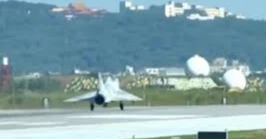
Taiwan’s Defense Ministry released footage showing its forces and weapons, including French-made Mirage 2000 fighter jets landing at an air base, as a show of readiness.
The tensions come as Taiwan accelerates plans to build a multilayered air defense system known as the “Taiwan Shield” or “T-Dome” to counter growing military threats.
The escalation followed comments by Taipei Mayor Chiang Wan-an, who said during a visit to Shanghai that he hoped the Taiwan Strait would be known for peace and prosperity rather than conflict.