
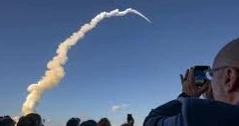
NASA has successfully launched the Artemis II mission, marking the first crewed journey into the moon’s vicinity since the Apollo programme concluded in 1972.
The 322-foot Space Launch System (SLS) rocket lifted off at 6:35pm ET (22:35 GMT) on Wednesday from Cape Canaveral, Florida, sending the Orion crew capsule on a 10-day mission.
Towering at the height of a 32-storey building, the rocket rose into the early evening sky before large crowds gathered near the launch site. The crew are now on a mission that will take them around the moon and back to Earth.
Originally targeted for launch as early as February 6 and later March 6, the mission faced delays after a hydrogen leak forced NASA to roll the rocket back to its vehicle assembly building for further inspection.
The mission had previously been scheduled for November 2024, but NASA announced a delay due to technical investigations, particularly involving the Orion’s heat shield.
Who is part of the Artemis II mission?
All three NASA astronauts are veterans of Earth-orbit science expeditions to the International Space Station, while the lone Canadian joining them on a voyage around the moon and back is a spaceflight rookie.
• Reid Wiseman, 50, commander: The NASA veteran and former International Space Station commander is leading the Artemis II mission. A test pilot-turned-astronaut, he has leadership and deep spaceflight experience.
• Victor Glover, 49, pilot: The US Navy aviator is the first Black astronaut assigned to a lunar mission and flew on SpaceX Crew-1.
• Christina Koch, 47, mission specialist: The record holder for the longest single spaceflight by a woman at 328 days is a veteran of multiple spacewalks and has scientific and deep-space mission expertise.
• Jeremy Hansen, 50, mission specialist: The first Canadian set to travel to the moon is a former fighter pilot. His presence represents international collaboration in deep space exploration.
With inputs from Al Jazeera