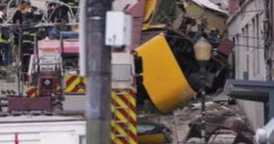
The number of fatalities in the crash of one of Lisbon’s iconic streetcars rose to 17 on Thursday after two more injured victims passed away, an emergency services official confirmed.
According to Margarida Castro Martins, head of Lisbon’s Civil Protection Agency, all of the deceased were adults. Their identities and nationalities have not yet been released, pending notification of their families.
In total, 23 people were injured in Wednesday’s accident. Among the injured were both Portuguese citizens and foreign nationals, including two Germans, two Spaniards, and one person each from France, Italy, Switzerland, Canada, Morocco, South Korea, and Cape Verde, Martins said.
The diversity of victims highlights the popularity of the historic streetcar, a major attraction for tourists visiting the Portuguese capital during the summer.
Thursday was declared a national day of mourning in Portugal, marking the deadliest incident in Lisbon in recent memory.
Though authorities have not disclosed the names of the victims, the transport workers’ union, SITRA, confirmed that André Marques, the streetcar's brakeman, was among those who died.
The 19th-century streetcar, part of the city’s heritage and a frequent feature on tourist itineraries, was packed at the time of the crash. It runs a short but scenic route up one of Lisbon’s steep hills.
Forensic experts worked through the night to complete autopsies, supported by specialists from other cities. The injured were taken to various hospitals in Lisbon.
As of Thursday, the mangled streetcar remained on the crash site in downtown Lisbon, surrounded by police tape. Investigators from Portugal’s judicial police documented the scene, photographing the rails and the wreckage on the quiet street.
Officials have not yet speculated on the cause, though possibilities include brake failure or a snapped cable.
The vehicle, officially known as the Elevador da Glória, lay on its side on the narrow, curving road where it derailed and slammed into a nearby building. Its top and sides were severely crushed by the impact.
Eyewitness Teresa d’Avó told Portuguese broadcaster SIC that the streetcar appeared to be out of control, barreling down the hill without braking. She described the crash as violent and said it scattered bystanders, some of whom fled into Avenida da Liberdade, the city’s main boulevard.
The crash occurred around 6 p.m. local time, at the beginning of the evening rush hour. Emergency crews managed to extract all victims from the wreckage within just over two hours.
Though commonly called a streetcar, the Elevador da Glória is technically a funicular, operating on steel cables and capable of carrying over 40 passengers. It serves both tourists and locals on a short route between Restauradores Square and the Bairro Alto nightlife district.
In response to the accident, Lisbon’s City Council suspended three other funicular streetcar services in the city for immediate safety inspections.
The Elevador da Glória is designated as a national monument.
Last year, Lisbon welcomed about 8.5 million tourists, with the streetcar being one of its most visited attractions. Long lines often form for the brief but scenic ride.
Carris, the company operating the funicular, stated that regular maintenance had been completed prior to the crash. In a statement posted to social media, the company extended condolences to the victims and their families and pledged a full investigation into the cause.
President Marcelo Rebelo de Sousa and Lisbon Mayor Carlos Moedas both expressed their sorrow, with Moedas calling it “a tragedy unlike any we’ve seen before.”
The Portuguese government formally declared Thursday a national day of mourning, stating that the crash caused “an irreparable loss of life” and had shaken the nation.
In solidarity, the European Parliament and European Commission flew EU flags at half-staff in Brussels. Several European leaders also shared messages of condolence.