
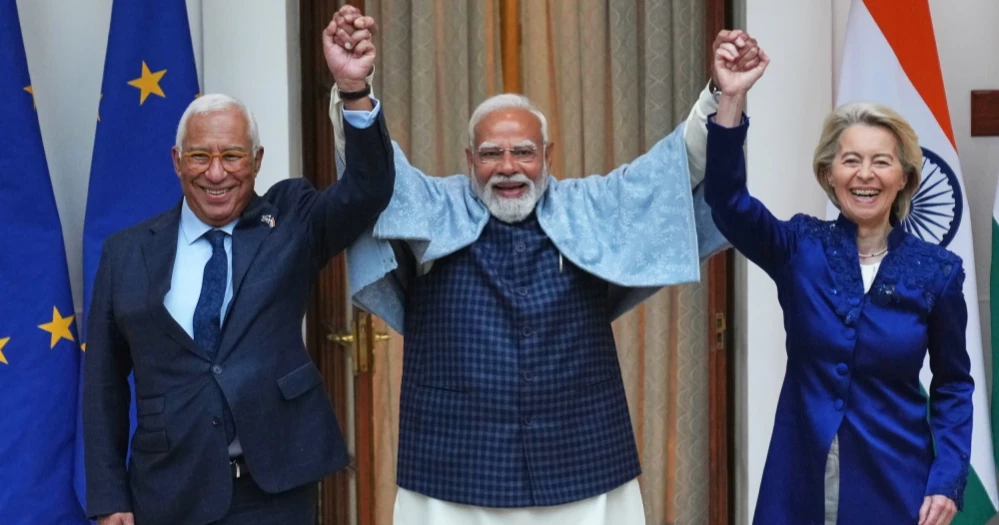
The European Union is seeking new trade partnerships worldwide as it aims to reduce dependence on the United States and strengthen its global influence. The EU recently signed a free trade agreement with India, part of a series of deals with countries including Japan, Indonesia, Mexico, and South America’s Mercosur nations.
The agreement with India, signed by European Commission President Ursula von der Leyen in New Delhi, could impact up to 2 billion people. It will remove tariffs on nearly 97% of EU exports to India, such as cars and wine, and 99% of Indian exports to the EU, including textiles and medicines. Observers say the deal strengthens ties between Brussels and New Delhi amid rising concerns over China and uncertainty in trans-Atlantic relations.
“The international order we relied upon for decades is no longer certain,” said Cyprus President Nikos Christodoulides, highlighting the EU’s push for a more autonomous and globally open union.
The EU has also pursued trade deals with Indonesia, Japan, South Korea, Australia, and is negotiating with the United Arab Emirates. A deal with the Mercosur nations was finalized recently, creating a free trade market of over 700 million people despite some opposition in the European Parliament.
Beyond trade, the EU is investing in its defense industry and infrastructure, spurred by Russia’s invasion of Ukraine and past criticism from the Trump administration over low European defense spending. The bloc has allocated 150 billion euros for projects including missile defense, drones, artillery, cyber systems, and artificial intelligence. Experts note that Europe’s goal is to build strategic autonomy and reduce reliance on U.S. military support.
Energy independence is another priority. The EU has increased U.S. energy imports while seeking alternative suppliers in the eastern Mediterranean and Gulf. Officials stress the need to diversify sources to avoid replacing one dependency with another.
Analysts say these moves show the EU’s effort to strengthen its global position and manage relations with China, Russia, and the U.S., ensuring both economic and strategic resilience.