
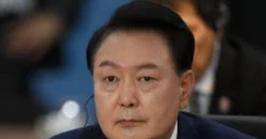
Former South Korean President Yoon Suk Yeol was sentenced to life imprisonment on Thursday for imposing martial law during what became the country’s most severe political turmoil in decades.
Yoon was removed from office after attempting to bypass an opposition-dominated National Assembly by declaring martial law and deploying troops around the legislature on Dec. 3, 2024.
Judge Jee Kui-youn of the Seoul Central District Court found Yoon guilty of rebellion, ruling that he unlawfully mobilized military and police forces in a bid to take control of the liberal-led Assembly, detain political leaders and consolidate sweeping authority for a prolonged period.
Martial Law Move Revived Memories of Authoritarian Era
The declaration — South Korea’s first in more than 40 years — evoked memories of past military-backed governments, when emergency decrees enabled the deployment of armed forces and armored vehicles to suppress dissent.
As lawmakers rushed to the Assembly, Yoon’s martial law command announced broad powers, including suspending political activities, restricting media operations and permitting arrests without warrants.
The order remained in effect for about six hours before lawmakers broke through a military blockade, secured a quorum and unanimously voted to revoke it.
Yoon was impeached on Dec. 14, 2024, suspended immediately and formally removed by the Constitutional Court in April 2025. He has been detained since July while facing multiple criminal cases, with the rebellion charge carrying the harshest penalty.
Defense Rejects Verdict
One of Yoon’s attorneys, Yoon Kap-keun, criticized the ruling as a “foregone conclusion” based solely on the prosecution’s arguments and claimed the country’s rule of law had collapsed. He said the legal team would consult on whether to appeal.
Yoon told the court that his declaration of martial law was intended only to alert the public to what he described as legislative obstruction by liberals and that he would have accepted lawmakers’ decision had they voted against the measure.
Prosecutors argued that Yoon sought to cripple the Assembly and block lawmakers from overturning the decree — actions that exceeded his constitutional authority even under martial law.
Judge Jee said the deployment of troops to the legislature was central to the rebellion conviction, noting that Yoon aimed to prevent lawmakers from assembling, deliberating or voting, thereby paralyzing the Assembly’s constitutional functions.
Supporters and Critics Gather
Heavy police presence surrounded the court as Yoon supporters rallied outside, chanting as the bus carrying him arrived. Critics also gathered nearby, calling for capital punishment. No major violence was reported after the ruling.
Although prosecutors had sought the death penalty, analysts widely anticipated a life sentence because the failed power grab did not result in fatalities. South Korea has effectively maintained a moratorium on executions since 1997.
Other Officials Also Punished
The court also sentenced several former officials involved in implementing the martial law decree. Former Defense Minister Kim Yong Hyun received 30 years in prison for his key role in orchestrating the move and mobilizing troops.
Last month, Yoon was handed a separate five-year sentence for resisting arrest, falsifying the martial law proclamation and bypassing a required full Cabinet meeting.
The Seoul Central District Court also convicted other Cabinet members, including Prime Minister Han Duck-soo, who was sentenced to 23 years for attempting to legitimize the decree and falsifying official records. Han has appealed.
Yoon is the first former South Korean leader to receive a life sentence since ex-military ruler Chun Doo-hwan, who was sentenced to death in 1996 over his 1979 coup, the deadly 1980 crackdown in Gwangju and corruption. His sentence was later commuted to life imprisonment, and he was pardoned in 1997. Chun died in 2021.