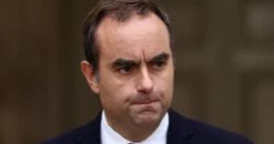
France plunged deeper into political instability as Prime Minister Sébastien Lecornu resigned just hours after announcing his new Cabinet — and less than a month into the role — amid mounting criticism and an inability to build consensus.
The French presidency confirmed Monday that President Emmanuel Macron accepted Lecornu’s resignation. Lecornu, a close Macron ally, had replaced François Bayrou, becoming the country’s fourth prime minister within a year.
In his resignation speech, Lecornu said the political environment made it impossible to lead effectively. “It would take very little for this to work — more selflessness from many, and a bit of humility. The country must come before party,” he said.
The sudden resignation triggered immediate political backlash. Far-right leader Marine Le Pen urged Macron to either dissolve the National Assembly or step down himself. “We’ve reached a dead end,” she said, calling for snap elections.
Left-wing parties also demanded Macron’s resignation, while others pushed to revive a broad leftist coalition of socialists, greens, and communists.
Markets reacted swiftly to the turmoil, with France’s CAC-40 stock index falling nearly 2% from Friday’s close. The newly appointed ministers — some not yet officially sworn in — were left in limbo, serving only in a caretaker capacity.
Ecology Minister Agnès Pannier-Runacher expressed her frustration on social media, writing: “I despair of this circus.”
Lecornu’s Cabinet choices drew criticism across the board, particularly his decision to name former Finance Minister Bruno Le Maire as defense minister — a move questioned due to his role in rising public deficits.
One of Lecornu’s key challenges was to pass a national budget amid France’s spiraling debt, which reached €3.346 trillion ($3.9 trillion), or 114% of GDP, by Q1 2025. Servicing this debt consumes about 7% of the state budget.
Several ministers from the previous government were retained, including Interior Minister Bruno Retailleau, Foreign Minister Jean-Noël Barrot, and Justice Minister Gérald Darmanin.
France’s political gridlock has persisted since last year’s snap elections, which produced a fragmented parliament. The far-right and far-left together control over 320 seats, while centrists and conservatives hold only 210.
Before resigning, Lecornu had consulted widely with political parties and unions in an attempt to form a consensus Cabinet. He pledged not to use the executive’s special constitutional powers to bypass Parliament on budget matters, promising instead to work with lawmakers across the spectrum.