
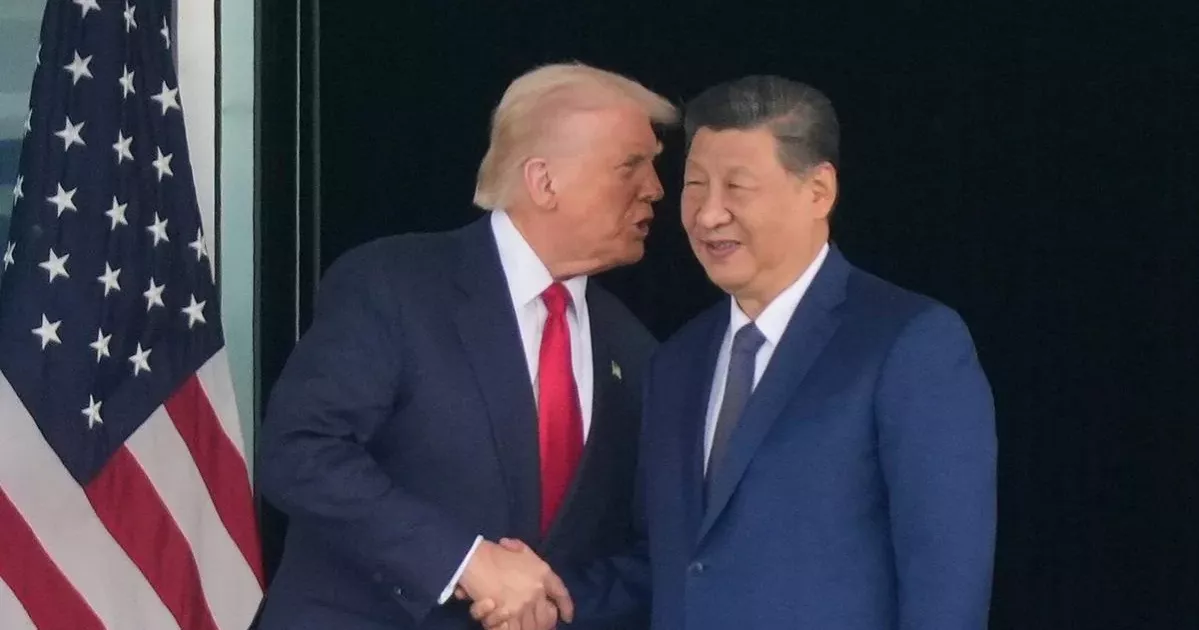
With one short post on Truth Social, President Donald Trump may have signaled a major shift in his approach to China — one that delights Beijing but unnerves many U.S. allies.
“The G2 WILL BE CONVENING SHORTLY!” Trump wrote before his Oct. 30 summit with Chinese President Xi Jinping in South Korea, reviving a term — “G2,” or Group of Two — that Washington had long abandoned.
Originally coined in 2005 by economist C. Fred Bergsten, “G2” referred to cooperation between the world’s two largest economies. Over time, it came to suggest a balance of power between the U.S. and China — an idea Beijing welcomes as recognition of its global stature but one that deeply worries American allies who fear being sidelined.
“The G2 concept implies the U.S. and China are equals on the world stage,” said Neil Thomas of the Asia Society Policy Institute.
Trump’s use of the term has sparked intense speculation about his administration’s China policy, which remains undefined as Beijing grows increasingly assertive.
A Term with Historical Weight
To grasp the significance of “G2,” analysts note China’s century-long sensitivity to Western “containment.” Since the early 2000s, Chinese diplomacy has sought to overturn that perception — a mission embodied in initiatives like the Belt and Road program, aimed at expanding China’s influence abroad.
Trump later praised his “G2 meeting with President Xi,” calling it “a great one for both countries” that would lead to “everlasting peace and success.” Defense Secretary Pete Hegseth also echoed the phrase online after speaking with China’s defense minister.
Former Biden administration official Mira Rapp-Hooper warned that Trump’s remarks likely “provoked significant anxiety in allied capitals,” where governments fear Washington could make bilateral deals with Beijing at their expense.
Beijing’s Reaction
Chinese commentators celebrated Trump’s adoption of the term. One nationalist blogger wrote that “Trump’s G2 means the U.S. has accepted it no longer holds a unipolar position,” implying a new bipolar world order with China as a peer — and diminishing Europe, Japan, and India.
At a Chinese Foreign Ministry briefing, spokesperson Guo Jiakun said the two countries “can jointly shoulder our responsibilities as major countries,” while still committing to “true multilateralism” and “an equal and orderly multipolar world.”
Scholar Zhao Minghao stressed that G2 “does not mean China and the U.S. co-ruling the world,” but rather a willingness to “re-examine the importance of their relationship” and boost communication.
A Controversial Revival
Bergsten, who first proposed the G2 concept, said he welcomed its renewed use, emphasizing that it was never meant to exclude other powers like the G7 or G20, but to foster necessary cooperation between the two economic giants.
“It’s not about the U.S. and China dictating to the world,” Bergsten said. “It’s about them talking through global economic issues.”
The term briefly gained traction during the Obama administration before being dropped due to backlash from allies such as Japan, Australia, and India, who saw it as Washington deferring to Beijing’s interests.
“It plays very poorly in those countries,” Rapp-Hooper said. “They fear being left out of decisions that affect their region.”
Former Deputy Secretary of State Kurt Campbell added that China often used the G2 concept to make neighboring nations “feel insecure,” which ultimately “powerfully delegitimized” the idea.