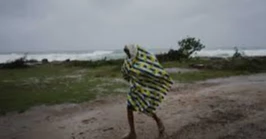
Hurricane Melissa slammed into eastern Cuba early Wednesday near Chivirico, in Santiago de Cuba province, as a Category 3 storm, after devastating Jamaica as one of the most powerful Atlantic hurricanes ever recorded, according to the U.S. National Hurricane Center (NHC).
Hundreds of thousands of Cubans were evacuated to shelters ahead of the storm. Hurricane warnings remained in effect for the provinces of Granma, Santiago de Cuba, Guantánamo, Holguín, and Las Tunas, as well as parts of the southeastern and central Bahamas.
As of early Wednesday, Melissa carried maximum sustained winds of 115 mph (185 kph) and was moving northeast at 12 mph (19 kph), the NHC said. The hurricane’s center was about 60 miles (97 km) west of Guantánamo and 230 miles (370 km) south of the central Bahamas.
Authorities warned residents to remain indoors, while preparations in the Bahamas were urged to be “rushed to completion.” The NHC forecast the storm to weaken slightly as it moved across Cuba on Wednesday morning, but remain a strong hurricane as it passed over the southeastern and central Bahamas later in the day. By late Thursday, Melissa is expected to approach Bermuda, where a hurricane watch is already in place.
Meteorologists warned of life-threatening floods and landslides from the torrential rains accompanying the storm.
Melissa had struck Jamaica on Tuesday with winds peaking at 185 mph (295 kph), toppling power lines and trees, and submerging large areas under floodwaters. Forecasters said the storm could produce a storm surge up to 12 feet (3.6 meters) and rainfall reaching 20 inches (51 cm) in eastern Cuba.
“Numerous landslides are likely in those regions,” said Michael Brennan, director of the National Hurricane Center in Miami.
Officials warned that the storm could worsen Cuba’s deepening economic crisis, already marked by fuel and food shortages and prolonged power outages.
“There will be a lot of work to do — we know there will be extensive damage,” Cuban President Miguel Díaz-Canel said in a televised address. He promised that “no one will be left behind” and pledged all available resources to protect lives. Díaz-Canel also urged citizens not to underestimate the storm, calling Melissa “the strongest hurricane ever to strike national territory.”
Classes were suspended Monday across provinces from Guantánamo to Camagüey, as authorities braced for impact.
In Jamaica, officials began damage assessments Wednesday after the hurricane’s direct hit. Severe flooding was reported in Clarendon and St. Elizabeth, with the latter parish described as “underwater,” said Desmond McKenzie, deputy chairman of Jamaica’s Disaster Risk Management Council.
Four hospitals were damaged — one left without power, forcing the evacuation of 75 patients, McKenzie said. More than 500,000 customers lost electricity across Jamaica late Tuesday, as fallen trees, power poles, and widespread flooding crippled the island’s infrastructure.
The Jamaican government said it hopes to reopen airports by Thursday to speed up the delivery of emergency aid.
So far, seven deaths across the Caribbean have been linked to Hurricane Melissa — three in Jamaica, three in Haiti, and one in the Dominican Republic, where one person remains missing.