Iran and the United States conducted indirect negotiations in Oman on Friday, with talks seemingly returning to the initial stage of determining how discussions on Tehran’s nuclear program should proceed. Notably, the United States included its senior military commander for the Middle East in the talks for the first time.
U.S. Navy Admiral Brad Cooper, head of Central Command, attended the meetings in full uniform in Muscat, underscoring the heightened military posture as the aircraft carrier USS Abraham Lincoln and other U.S. warships remain positioned near Iran in the Arabian Sea.
President Donald Trump described the talks as “very good” and said additional meetings are planned for early next week. However, he also issued a warning, saying Iran would face severe consequences if it failed to reach an agreement on its nuclear program.
Speaking to reporters aboard Air Force One late Friday, Trump said Iran appeared eager to strike a deal and hinted that Tehran may be willing to offer more than in past negotiations, though he did not provide specifics. Asked how long he would wait for progress, Trump said the U.S. was not in a hurry, referencing the lengthy pressure campaign used against Venezuela prior to the capture of then-President Nicolás Maduro earlier this year.
Trump has repeatedly threatened military action to force Iran into an agreement, particularly after the U.S. deployed the aircraft carrier to the region amid Iran’s violent suppression of nationwide protests that left thousands dead and tens of thousands detained. Gulf Arab states have warned that any strike could ignite a broader regional conflict.
Tensions remain high. In recent days, U.S. forces shot down an Iranian drone near the Abraham Lincoln, and Iran attempted to intercept a U.S.-flagged vessel in the Strait of Hormuz shortly before the Oman talks.
Iranian Foreign Minister Abbas Araghchi said negotiations must take place without intimidation, stressing that dialogue requires a calm environment free from threats or pressure. He confirmed that the current round of talks had concluded and that diplomats would return to their respective capitals. The U.S. delegation included Middle East envoy Steve Witkoff and Jared Kushner, President Trump’s son-in-law.
In a show of military strength, the U.S. military shared images on X of the carrier strike group operating in the Arabian Sea, accompanied by the message “Peace through Strength!”
Despite the tensions, Araghchi struck a cautiously hopeful tone in a live interview on Iranian state television, saying the discussions focused on establishing a framework for future negotiations. He acknowledged that deep mistrust remains a major obstacle and said addressing it is essential before moving forward.
Oman’s Foreign Minister Badr al-Busaidi, who facilitated the talks, said they helped clarify both sides’ positions and identify potential areas for progress. Earlier plans to hold talks in Turkey — with broader regional participation and discussion of Iran’s missile program — were reportedly rejected by Tehran, which insists negotiations focus solely on nuclear issues.
Before Israel’s 12-day conflict with Iran in June, Tehran had enriched uranium to 60% purity, a level close to weapons-grade. The International Atomic Energy Agency has warned that Iran is the only country enriching uranium at that level without possessing nuclear weapons. Iran has since denied the IAEA access to sites struck during the June war and has restricted inspections since the U.S. withdrew from the 2015 nuclear deal in 2018.
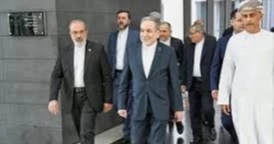
Friday’s meetings took place at a palace near Muscat’s international airport, a venue previously used for Iran–U.S. negotiations. Journalists observed Iranian officials arriving first, followed later by the American delegation.
While Iran has said the talks are limited to its nuclear program, Al Jazeera reported that Egypt, Turkey, and Qatar presented a proposal under which Iran would suspend uranium enrichment for three years, export its highly enriched uranium, and commit not to initiate the use of ballistic missiles. Russia reportedly offered to receive the uranium, but Iran has rejected both halting enrichment and shipping the material abroad. U.S. Secretary of State Marco Rubio has said all these issues must be addressed.
Shortly after the talks concluded, the U.S. Treasury and State Departments announced new sanctions targeting Iran’s energy sector. The measures include asset freezes on 14 oil tankers linked to a so-called “shadow fleet,” as well as sanctions on 15 trading firms and two executives accused of helping Iran evade restrictions.
Trump also signed an executive order allowing for possible tariffs of up to 25% on imports from countries purchasing Iranian oil. While the order does not immediately impose tariffs, it gives the president authority to do so beginning Saturday, with provisions allowing their removal if Iran or its oil buyers align with U.S. national security and foreign policy interests.
In recent weeks, the U.S. has also sanctioned several Iranian officials, including the interior minister and senior security figures, over their roles in the deadly crackdown on last month’s protests.