
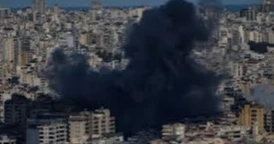
Iran carried out fresh attacks on Israel and several Gulf nations on Tuesday, continuing to intensify tensions across the Middle East. The ongoing conflict has shaken the region and global markets, pushing oil prices higher and creating economic uncertainty worldwide.
Warning sirens sounded in Dubai and Bahrain as missiles were detected, while Saudi Arabia reported destroying two drones over its oil-rich eastern region. Kuwait’s National Guard also said it intercepted six drones. Later, sirens rang out in Jerusalem, and explosions were heard in Tel Aviv as Israel’s defense systems tried to stop incoming missiles after detecting an Iranian launch.
Iran’s parliament speaker, Mohammad Bagher Qalibaf, said on social media that Iran was not seeking a ceasefire and insisted that the aggressor must be strongly punished to prevent future attacks on the country.
Besides launching missiles and drones toward Israel and U.S. bases in the region, Iran has targeted energy infrastructure. Its control over the Strait of Hormuz has also disrupted oil supply routes, causing oil prices to surge. Brent crude briefly climbed close to $120 per barrel before dropping, though it remained around $90 on Tuesday—about 24% higher than when the conflict began on Feb. 28.
U.S. President Donald Trump attempted to ease concerns that the war might drag on, saying he believed it would be a short-term conflict, despite earlier suggesting it could last a month or more. Meanwhile, Israeli Prime Minister Benjamin Netanyahu stated that Israel would continue its strikes on Iran and suggested that Iranians themselves must ultimately decide to end what he called oppressive rule.
The fighting has disrupted global energy supplies, increased fuel costs, and forced many foreign workers to leave major business centers. Millions of residents have sought shelter as airstrikes hit military facilities, government sites, oil and water infrastructure, hotels, and even a school.
Iran has also effectively halted tanker traffic through the Strait of Hormuz, a crucial shipping route carrying about 20% of the world’s oil. Attacks on commercial ships near the strait have reportedly killed at least seven sailors.
Trump warned that if Iran blocks oil shipments through the strait, the United States would respond with much stronger military action. In response, a spokesperson for Iran’s Revolutionary Guard said Iran itself would decide when the conflict ends.
Iranian officials have indicated they are prepared for a prolonged war. Kamal Kharazi, a senior foreign policy adviser to Iran’s supreme leader, said diplomacy is unlikely unless international pressure forces others to intervene and stop what he described as aggression by the United States and Israel.
In a separate development, five members of Iran’s women’s national soccer team, who were in Australia for a tournament when the conflict began, have been granted asylum there. The players gained attention after refusing to sing Iran’s national anthem before their first match. Australia’s Home Affairs Minister Tony Burke said the women were excited to begin a new life in the country. All 26 players were reportedly offered asylum, though it is unclear whether the rest of the team will remain.
The conflict has also spread to neighboring countries. Israel has launched attacks on Hezbollah positions in Lebanon, while the Iran-backed group has fired missiles into Israel. In Iraq, pro-Iran militias have targeted U.S. bases since the war began.
Early Tuesday, an airstrike hit the 40th Brigade of the Popular Mobilization Forces in Kirkuk, killing at least five fighters and injuring four others. Officials did not immediately say who carried out the attack.
Israel also announced a series of strikes against Hezbollah’s financial network, including the group’s al-Qard al-Hasan organization, which Israel says helps fund Hezbollah’s military operations. The Israeli military again urged residents in southern Lebanon to evacuate, saying it planned stronger operations against the group.
Since the conflict started, officials report that at least 1,230 people have died in Iran, 397 in Lebanon, and 11 in Israel. Seven U.S. service members have also been killed.
Global financial markets, which have been volatile due to the conflict, showed some recovery in Asia on Tuesday following late optimism in the United States.
Meanwhile, Saudi Arabia’s state oil giant Aramco reported profits of $104 billion for 2025, down from $110 billion the previous year. The company said its annual revenue also fell to $445 billion from $480 billion in 2024.