
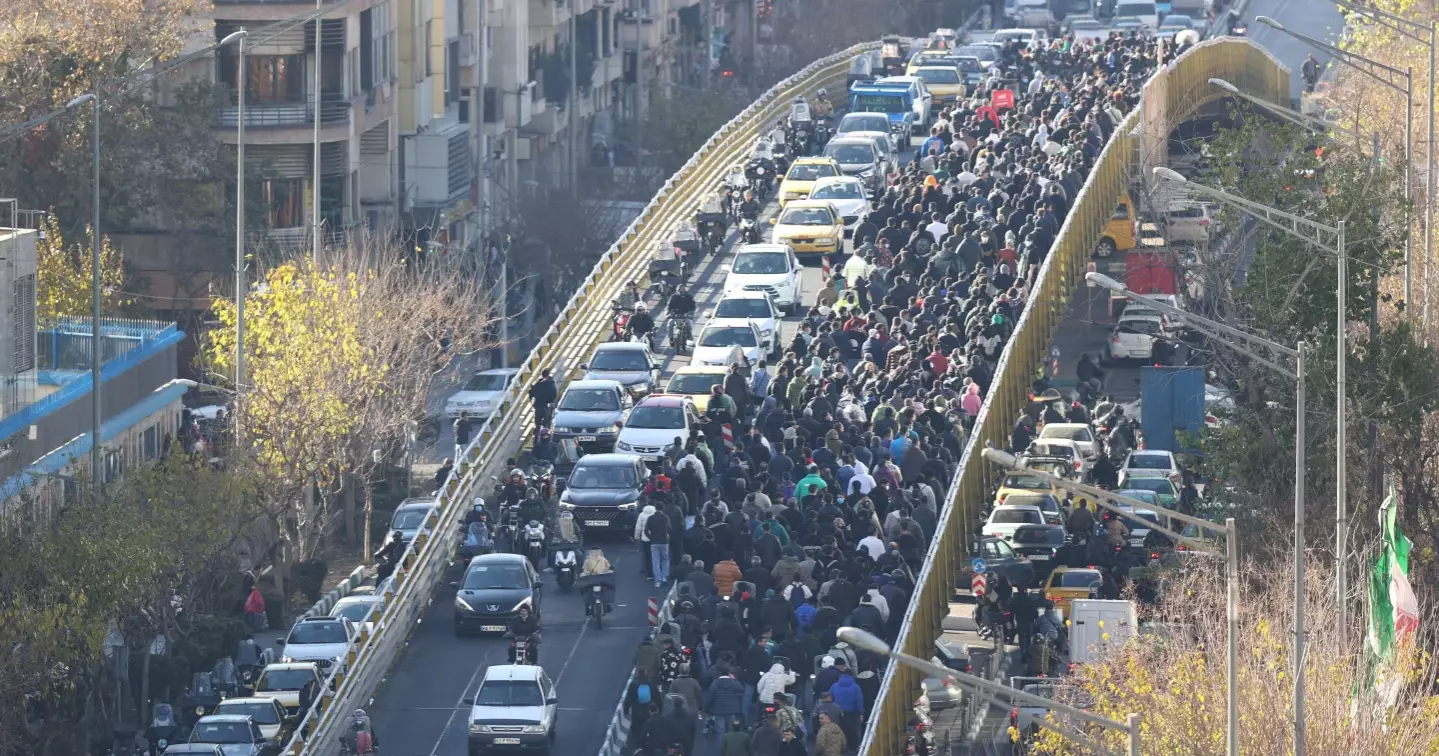
Expanding protests driven by Iran’s deepening economic crisis are piling fresh pressure on the country’s clerical leadership, already weakened by war, sanctions and strained regional alliances.
Tehran is still grappling with the fallout from a 12-day war launched by Israel in June, during which the United States struck Iranian nuclear sites. Since September, renewed United Nations sanctions over Iran’s atomic programme have intensified economic stress, sending the rial into a sharp decline. The currency is now trading at about 1.4 million to the US dollar.
At the same time, Iran’s so-called “Axis of Resistance”, a network of allied states and militant groups backed by Tehran, has suffered major setbacks since the start of the Israel-Hamas war in 2023.
US President Donald Trump’s warning that Washington would intervene if Iran “violently kills peaceful protesters” has taken on added weight following the US capture of Venezuelan President Nicolás Maduro, a close ally of Tehran.
“We’re watching it very closely,” Trump told reporters aboard Air Force One late Sunday. He said Iran would face a strong response if security forces again resorted to lethal crackdowns.
Protests have spread to more than 220 locations across 26 of Iran’s 31 provinces, according to the US-based Human Rights Activists News Agency. At least 19 people have been killed and more than 990 arrested, the group said. Iranian state media has offered little coverage, while restrictions on journalists and limited online footage have made it difficult to independently assess the scale of the unrest.
The demonstrations began with merchants in Tehran before spreading nationwide. While initially focused on economic grievances, protesters have increasingly voiced anti-government slogans. Public anger has been building for years, particularly since the 2022 death of Mahsa Amini in police custody sparked mass protests.
Iran’s economy has been battered by soaring prices for basic goods, with annual inflation hovering around 40 percent. In December, authorities raised prices under a new tiered system for subsidised gasoline, further squeezing households and fuelling fears of steeper hikes ahead as prices are now reviewed quarterly.
Regionally, Iran’s influence has weakened. Israel has severely degraded Hamas in Gaza and dealt heavy blows to Hezbollah in Lebanon. In Syria, President Bashar Assad, a longtime Iranian ally, was overthrown in a rapid offensive in December 2024. Iranian-backed Houthi rebels in Yemen have also faced sustained US and Israeli airstrikes. While China continues to buy Iranian oil, it has offered no direct military backing, nor has Russia.
Western powers remain alarmed over Iran’s nuclear activities. Although Tehran insists its programme is peaceful, it had been enriching uranium to near weapons-grade levels before the June attacks. Iran has also reduced cooperation with the International Atomic Energy Agency, whose chief has warned Tehran could build up to 10 nuclear bombs if it chose to weaponise its programme.
US intelligence agencies say Iran has not yet decided to build a nuclear weapon but has taken steps that could enable it to do so. Tehran recently claimed it had halted uranium enrichment nationwide, signalling possible openness to negotiations, though no substantive talks have followed the June conflict.
Relations between Iran and the United States remain deeply strained, shaped by decades of hostility since the 1979 Islamic Revolution, the US embassy hostage crisis, years of proxy conflicts and Washington’s withdrawal from the 2015 nuclear deal under Trump in 2018. Those tensions have only intensified amid the latest unrest and regional turmoil.