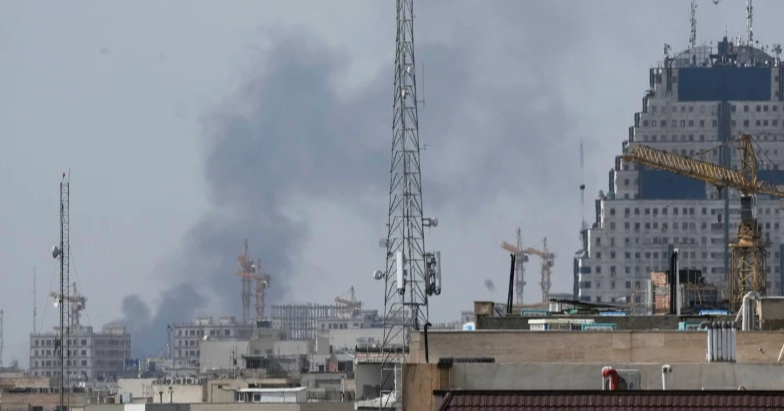
Iran’s Cabinet issued a warning early Sunday that a “great crime will never go unanswered” following what it said was a joint U.S.-Israeli military operation that killed Supreme Leader Ayatollah Ali Khamenei.
The warning came after Iranian state media reported that Khamenei, 86, was killed in an airstrike that hit his compound in central Tehran.
Iranian state television interrupted its broadcast to announce his death.
“To the noble and proud people of Iran: With the ultimate grief and sorrow this is to inform you that following the barbaric attack by the criminal governments of America and the evil Zionist regime, the true example of faith, jihad and resistance, the Supreme Leader of the Revolution Grand Ayatollah Khamenei achieved the blessing of martyrdom,” the anchor said.
Semi-official media reported that Khamenei’s daughter and son-in-law were among those killed in the U.S.-Israeli strikes.
The Fars News Agency, citing unidentified sources, also said a grandchild and a daughter-in-law died in Saturday’s attacks, without providing further details.
Iran’s government announced 40 days of national mourning and declared a seven-day nationwide public holiday in memory of the late leader, reports AP.
State television said Khamenei was inside his Tehran compound when the attack began, adding that satellite images from Airbus showed extensive bombing damage at the site.
His death at his workplace, state TV said, “showed that he consistently stood among the people and at the forefront of his responsibilities, confronting what officials call global arrogance.”
Iranian state media later formally confirmed that Ayatollah Ali Khamenei had died.
State television and the state-run IRNA news agency reported his death without giving further details.
U.S. President Donald Trump had earlier said Khamenei was killed in a joint American-Israeli operation against Iran.
Australian Prime Minister Anthony Albanese said he backs U.S. actions aimed at preventing Iran from threatening global peace and security. “We support the United States acting to prevent Iran from obtaining a nuclear weapon and to prevent Iran continuing to threaten international peace and security,” Albanese wrote on social media on Saturday.
The Arab League said the Israeli-U.S. airstrikes marked a point at which the Arab-Israeli conflict had turned into a “full-scale regional war.”
Its U.N. observer, Maged Abdelaziz, told an emergency meeting of the Security Council that Israel was using the Iran conflict to avoid ending its occupation of Palestinian territories and to impose its “hegemony on the Middle East by using military means.”
Despite reports of limited progress in U.S.-Iran talks in Geneva two days earlier, Abdelaziz said Israel carried out “a wanton military attack” that it claimed “was intended to prevent Iran from acquiring nuclear weapons.”
He added, “At the same time, Israel itself refuses to join the Nuclear Non-Proliferation Treaty,” and declines to place its nuclear facilities under the safeguards of the International Atomic Energy Agency.
The IAEA said its Board of Governors will hold a special session in Vienna on Monday after a request from Russia.
A diplomatic note dated Feb. 28 said the meeting would address “matters related to military strikes of the United States and Israel against the territory of the Islamic Republic of Iran that started in the morning of 28 February 2026, preceded by repeated open threats of such action, including against nuclear facilities under the IAEA safeguards.” The session will be held ahead of the board’s regular meeting.