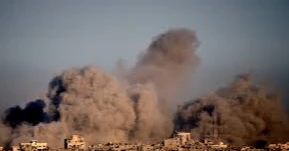
Israel and Hamas have agreed to a temporary halt in hostilities in Gaza to facilitate the release of the remaining hostages in exchange for Palestinian prisoners. The agreement reflects key elements of a peace proposal introduced by the Trump administration, which Palestinians cautiously welcomed on Thursday as a potential turning point in the ongoing two-year conflict.
“This means that ALL of the Hostages will be released very soon, and Israel will withdraw their Troops to an agreed upon line as the first steps toward a Strong, Durable, and Everlasting Peace,” former U.S. President Donald Trump wrote on social media late Wednesday. He added that “all parties will be treated fairly.”
For many Palestinians displaced by the war, the news brought relief. Alaa Abd Rabbo, originally from northern Gaza, said, “We are tired, we have been displaced, and this is the day we have been waiting for. We want to go home.”
In Tel Aviv, families of the remaining hostages celebrated with tears and Champagne following the announcement of the deal.
According to individuals familiar with the agreement, Hamas is expected to release all 20 surviving hostages within days, while Israeli forces will begin a phased withdrawal from most areas of Gaza. The sources spoke anonymously, as the deal has not been fully disclosed publicly.
Key issues, including Hamas’ potential disarmament and the future governance of Gaza, remain unresolved. Still, both sides appear closer than they have been in months to ending a conflict that has devastated Gaza, killed tens of thousands, and sparked unrest across the region.
The war began on October 7, 2023, after a deadly Hamas-led attack on Israel, and has since triggered global protests and allegations of genocide — claims that Israel strongly denies.
Negotiations leading to the agreement took place in Egypt and concluded after three days of talks.
“We will bring them all home, with God’s help,” said Israeli Prime Minister Benjamin Netanyahu on social media, announcing that he would present the deal to his government for approval on Thursday.
Hamas, in turn, urged Trump and other mediators to ensure Israel fulfills its commitments, including troop withdrawals, prisoner releases, and aid access into Gaza.
Despite the announcement, skepticism remains among some Palestinians. Dr. Ahmed al-Farra, a pediatrician at Nasser Hospital in Khan Younis, said, “We need to go back to living,” while expressing doubts based on past experiences.
Trump’s Peace Framework
The Trump plan calls for an immediate ceasefire and the release of the remaining 48 hostages abducted during the October 2023 Hamas-led attack, which left 1,200 dead and 251 hostages taken. Only about 20 of those hostages are believed to be alive today.
In an interview with Fox News, Trump stated that the release of hostages could begin as early as Monday, adding, “This is more than Gaza. This is peace in the Middle East.”
Under the proposal, Israel would retain a military presence along Gaza’s border, while an international force—primarily from Arab and Muslim-majority countries—would oversee security within the territory. The United States would lead a major international effort to rebuild Gaza.
The plan also includes a future role for the Palestinian Authority (PA), although Netanyahu opposes such involvement. Any PA participation would require major internal reforms, potentially taking years. The plan remains vague on the question of Palestinian statehood—an issue Netanyahu has firmly rejected.
Despite the uncertainty, both Palestinians and Israelis expressed cautious optimism.
“This is a huge day, a huge joy,” said Ahmed Sheheiber, a displaced Palestinian from northern Gaza, speaking from a shelter in Gaza City. He said he was eagerly awaiting the ceasefire so he could return to his home in the Jabaliya refugee camp.
In Tel Aviv, hostage families and supporters gathered in the city’s central square. Einav Zangauker, mother of captive Matan Zangauker and a leading voice in the campaign to free hostages, told reporters, “If I have one dream, it is seeing Matan sleep in his own bed.”
Breakthrough After Months of Stalemate
Trump’s Middle East envoy, Steve Witkoff, and his son-in-law Jared Kushner participated in the Egypt talks, alongside Qatari Prime Minister Sheikh Mohammed bin Abdulrahman Al Thani and Israeli adviser Ron Dermer. Trump said he may visit the region in the coming days.
This would be the third truce since the war began. The first ceasefire in November 2023 resulted in over 100 hostages being released in exchange for Palestinian detainees. That truce collapsed quickly. A second agreement earlier this year saw 25 hostages freed, along with the bodies of eight others, in return for nearly 2,000 Palestinian prisoners, but it also ended abruptly in March following an Israeli airstrike.
Human Cost of the Conflict
The war has taken a severe toll on civilians. Over 67,000 Palestinians have been killed and nearly 170,000 injured, according to Gaza’s Hamas-run Health Ministry, which is considered a credible source by the UN and independent observers. The ministry reports that about half the deaths were women and children, though it does not distinguish between civilians and combatants.
Much of Gaza lies in ruins, with many families living in makeshift shelters along the beach. Thousands have been displaced by the latest Israeli offensive in the north.
Among them is Ayman Saber from Khan Younis, who said he plans to return and rebuild his home, destroyed by an Israeli airstrike.
“I will rebuild the house. We will rebuild Gaza,” he said.