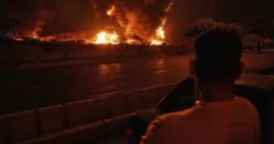
For the third day in a row, Israel launched airstrikes across Iran on Sunday, escalating tensions and hinting at further military action. Some Iranian missiles bypassed Israeli air defenses and hit targets deep inside Israel, while nuclear negotiations that might have helped ease the crisis were abruptly called off.
The region is now bracing for a prolonged confrontation after Israel’s initial attack on Friday struck Iranian nuclear and military facilities, killing high-ranking generals and nuclear scientists. Iran claims two of its oil refineries were hit, raising fears of a broader attack on its energy sector — already under heavy international sanctions — with possible global economic consequences.
Israel’s military issued warnings via social media, advising Iranians to evacuate weapons manufacturing sites, suggesting that its campaign may soon expand. Explosions were once again heard in Tehran around midday.
U.S. President Donald Trump has voiced full support for Israel’s actions while warning Iran that it must agree to a new nuclear deal to avoid further damage.
Iran’s Foreign Minister, Abbas Araghchi, stated that if Israel halts its strikes, Iran will stop retaliating. He also accused the United States of being complicit in the attacks and said it must be held accountable.
Tehran Rocked by New Explosions
Explosions continued in Tehran and other cities early Sunday. No updated death toll was provided after Iran's U.N. ambassador reported the previous day that 78 people were killed and over 320 injured.
In Israel, Iranian missile attacks overnight and into Sunday killed at least 10 people, bringing the total death toll there to 13. Israel’s main airport remained closed for a third day.
Israeli strikes on Sunday targeted Iran’s Defense Ministry and other key military and nuclear infrastructure. The targeted killings of top figures suggest Israeli intelligence has deeply infiltrated Iranian security.
Heavy Civilian Toll in Israel
Among the dead in Israel were six people — including two children — killed when a missile hit an apartment block near Tel Aviv. Another missile killed four people, including a teenager, in the Arab town of Tamra, while a separate strike wounded 42 in Rehovot. The Weizmann Institute of Science in Rehovot reported some buildings were hit, but no injuries occurred there.
Though Israel has advanced missile defense systems, officials acknowledge they’re not foolproof.
Global Leaders Call for Calm
World leaders are urging both nations to deescalate. China’s foreign minister warned that attacking nuclear facilities sets a dangerous precedent. Meanwhile, the conflict in Gaza between Israel and Hamas — an Iranian-backed group — continues to add pressure in the region.
Prime Minister Benjamin Netanyahu dismissed the global concerns, promising even harsher Israeli retaliation in the coming days. Israel, which is widely believed to have nuclear weapons (though it has never confirmed it), claims the strikes are intended to prevent Iran from building a nuclear bomb.
Iran insists its nuclear program is peaceful. However, it has significantly increased its uranium enrichment in recent years and is believed to be close to having enough material for multiple nuclear weapons.
Damage to Iranian Energy and Nuclear Sites
Iran’s Foreign Minister Araghchi confirmed Israeli strikes hit oil facilities near Tehran and in Bushehr province. He also said Iran retaliated by targeting Israeli “economic” sites, without offering specifics.
Iranian media reported a strong explosion at a natural gas plant caused by an Israeli drone strike. Israel did not immediately comment, but such facilities are usually protected by air defense systems — which Israel has also targeted.
In northern Israel, a strike damaged an oil refinery in Haifa, forcing parts of the operation to shut down. No injuries were reported.
Nuclear Talks Suspended
Oman, which had been mediating indirect nuclear talks between the U.S. and Iran, announced that the next scheduled round was canceled. A senior U.S. official expressed hope the talks could resume soon.
However, Araghchi said resuming negotiations was now "unjustifiable," blaming Israel’s attacks and what he called direct U.S. support.
Former President Trump, in a Truth Social post, denied U.S. involvement in the Israeli strikes and warned Iran that any attack on the U.S. would trigger an unprecedented response. He also claimed a peace deal between Iran and Israel could be achieved.
Serious Damage at Iranian Nuclear Facilities
Satellite imagery from Natanz showed major destruction to multiple buildings, including those that provide power to the uranium enrichment facility. The International Atomic Energy Agency (IAEA) said the above-ground areas were destroyed but the main underground centrifuge plant appeared intact — although the power loss could still compromise its operations.
In Isfahan, Israel targeted a nuclear research center, damaging four key buildings, including a uranium conversion site. No radiation leaks have been reported.
An Israeli military source said repairs to Natanz and Isfahan will take "far longer than a few weeks" and claimed intelligence shows Iran was using the Isfahan site for military nuclear purposes.