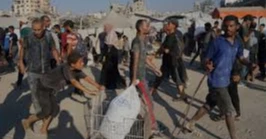
The Israeli military has initiated a daily 10-hour pause in fighting across three densely populated areas of Gaza, starting Sunday, in response to growing international pressure and escalating concerns about widespread hunger in the region amid the ongoing 21-month conflict.
The military announced the "tactical pause" would occur each day from 10:00 a.m. to 8:00 p.m. local time in Gaza City, Deir al-Balah, and Muwasi. The move is aimed at facilitating the delivery of humanitarian aid. Along with these pauses, Israel is establishing safe corridors for aid and has carried out airdrops of essentials like flour, sugar, and canned food.
Warnings about famine in Gaza have been circulating for months. Israel has limited aid flow, claiming—without evidence—that Hamas diverts the supplies for its own use. Recent images of severely malnourished children have intensified global condemnation, including from Israel's close allies, who are urging an end to the war and the growing humanitarian disaster.
Despite the pauses, Israel's military operations against Hamas continue elsewhere in Gaza. Prior to the pause, Gaza health officials reported that at least 16 Palestinians were killed in separate airstrikes.
Dr. Muneer al-Boursh, head of Gaza’s Health Ministry, stated that the humanitarian pauses would be meaningless without a large-scale influx of medical and nutritional supplies, especially for children. "Every delay results in another death," he said.
These local pauses come shortly after ceasefire negotiations between Israel and Hamas stalled. On Friday, both Israel and the U.S. withdrew their delegations, blaming Hamas and signaling that Israel was considering other strategies.
Senior Hamas leader Mahmoud Merdawi criticized the Israeli pause, calling it a public relations move to improve Israel’s image rather than to address the crisis. He added that Israel would face consequences for its actions.
After halting aid entirely in March to pressure Hamas into releasing hostages, Israel slightly loosened restrictions in May. Since then, approximately 4,500 aid trucks have entered Gaza—about 69 per day—far short of the 500–600 daily trucks the U.N. says are needed. The U.N. also reports difficulties in distributing aid due to looting by desperate crowds and armed groups.
To bypass U.N. aid mechanisms, Israel has supported a U.S.-based group, the Gaza Humanitarian Foundation, which operates four food distribution centers. However, according to the U.N. human rights office, over 1,000 Palestinians have been killed—mostly near these centers—while trying to obtain food.
Israel has repeatedly accused the U.N. of enabling Hamas to steal aid, an allegation the U.N. denies, asserting that its system remains the most effective for delivering assistance.
The Israeli military stated the new steps were coordinated with the U.N. and other aid organizations, though the U.N. has not yet responded.
Gaza's population, forced into increasingly cramped areas due to ongoing fighting, depends heavily on humanitarian aid.
New Airstrikes Kill at Least 16
Among the latest attacks, a strike on a tent in the Asdaa area near Khan Younis killed at least nine people, including multiple family members, according to Nasser Hospital. In Gaza City, a separate strike on an apartment killed four people, including two women. In Deir al-Balah, a strike near a desalination plant killed three more, including a couple and another woman, according to Al-Aqsa Martyrs Hospital.
The Israeli military did not comment on these incidents but reported the deaths of two more soldiers in Gaza, bringing the total military fatalities to 898 since October 7, 2023.
The conflict began with Hamas’ surprise attack on southern Israel, which killed 1,200 people and led to 251 hostages being taken. Israel says Hamas still holds 50 hostages, over half believed to be dead.
In response, Israel’s ongoing offensive has killed more than 59,700 Palestinians, according to Gaza’s Health Ministry. While it does not distinguish between militants and civilians, the ministry reports that over half of the casualties are women and children. Despite being under Hamas control, the ministry’s casualty data is widely regarded by the U.N. and other global bodies as the most reliable available.