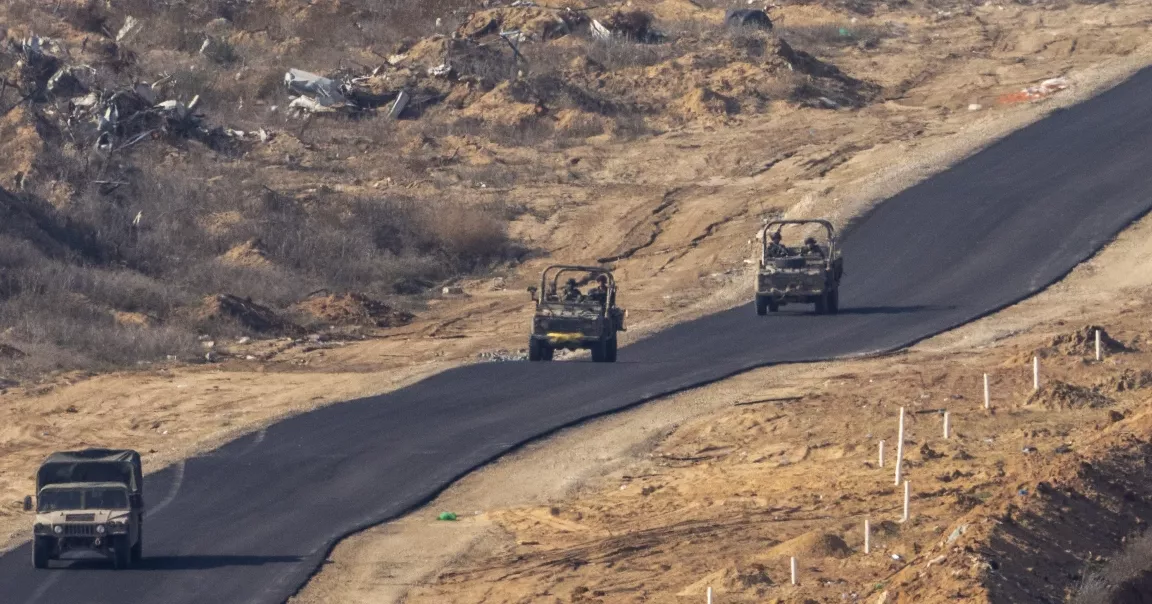
TEL AVIV, Israel (AP/UNB) — Israel has significantly increased its presence in the Gaza Strip since resuming its military campaign against Hamas last month, now controlling more than half of the territory and forcing Palestinians into ever-smaller areas.
The largest continuous zone under Israeli control lies along the Gaza border, where soldiers and rights groups report that homes, farmland, and infrastructure have been systematically destroyed to render the area uninhabitable. In recent weeks, the size of this military buffer zone has doubled.
Israel says this intensified control is a temporary measure aimed at pressuring Hamas to free the hostages taken during the Oct. 7, 2023, attack that triggered the war. However, human rights groups and experts on Gaza warn that the territory now under Israeli control—including a corridor dividing Gaza’s north and south—could be used to maintain a long-term presence.
Prime Minister Benjamin Netanyahu stated last week that even after Hamas is defeated, Israel will maintain security control over Gaza and encourage Palestinian emigration.
According to five Israeli soldiers who spoke to The Associated Press, the destruction near the border and the expansion of the buffer zone have been ongoing since the war began 18 months ago.
“They destroyed everything they could, they shot everything that looks functioning ... (the Palestinians) will have nothing to come back, they will not come back, never,” said one soldier from a tank unit guarding demolition teams. He and four others spoke on condition of anonymity due to fear of repercussions.
Breaking The Silence, an anti-occupation group made up of Israeli military veterans, released a report Monday detailing testimonies from soldiers stationed in the buffer zone, including some who spoke to AP. They described the zone being transformed into a desolate wasteland.
“Through widespread, deliberate destruction, the military laid the groundwork for future Israeli control of the area,” the group stated.
The Israeli military, responding to the accounts, said its operations are designed to protect the country and especially southern communities that suffered in the Oct. 7 assault, which killed around 1,200 people and resulted in 251 hostages. The army emphasized it does not target civilians and follows international law.
Carving Gaza into sections
In the early stages of the war, Israeli forces displaced Palestinians living near the border and destroyed the land to create a buffer zone extending over a kilometer (0.62 miles) into Gaza, according to Breaking The Silence.
Israeli troops also took control of the Netzarim Corridor, a strip of land cutting off Gaza’s north, including Gaza City, from the rest of the densely populated coastal enclave.
Since resuming the offensive last month, Israel has further expanded the buffer zone, pushing it up to 3 kilometers (1.8 miles) into Gaza in certain areas, according to military-issued maps.
Combined, the buffer zone and the Netzarim Corridor now make up at least half of Gaza, according to Yaakov Garb, an environmental studies professor at Ben Gurion University who has long studied land use in the region.
Netanyahu also recently announced plans to establish another corridor in southern Gaza, isolating the city of Rafah. Israel's control extends even further when considering regions where civilians were ordered to evacuate ahead of military operations.
Neighborhoods turned into rubble
The buffer zone was once home to hundreds of thousands of Palestinians and served as a vital agricultural hub.
Satellite images reveal flattened neighborhoods and nearly a dozen new Israeli army outposts since the ceasefire ended.
Nidal Alzaanin, who returned to his home in Beit Hanoun during a ceasefire in January, found it destroyed. His land, greenhouse, and a 150-year-old sycamore tree planted by his great-grandfather were all gone. Only a few personal mementos remained amid the ruins.
The 55-year-old farmer set up a tent in the rubble, hoping to start over. But when Israel renewed its offensive and took control of his land, he was displaced again.
“It took 20 years to build a house and within five minutes they destroyed all my dreams and my children’s dreams,” he said from Gaza City, where he now seeks shelter.
While the war has led to destruction throughout Gaza, soldiers said the razing within the buffer zone has been especially systematic and extensive.
The five soldiers told AP that troops were instructed to destroy farmland, irrigation systems, crops, and thousands of buildings, including homes and public facilities, to eliminate any cover for militants.
Several soldiers described demolishing more structures than they could count, including factories. One recounted how a soda factory was flattened, leaving only shards of glass and broken solar panels.
Soldier alleges buffer zone was a ‘kill’ zone
According to the soldiers, there were no clear boundaries to the buffer zone, and any Palestinian entering it was at risk of being shot.
The tank unit soldier said an armored bulldozer cleared land to create a “kill zone” where anyone within 500 meters of the tanks—including civilians—was targeted.
Visibly distressed, he said many soldiers were motivated by revenge over the Oct. 7 attacks.
“I came there because they kill us and now we’re going to kill them. And I found out that we’re not only killing them. We’re killing them, we’re killing their wives, their children, their cats, their dogs, and we destroyed their houses,” he said.
The army stated its strikes are intelligence-based and that it strives to minimize civilian harm.
Long-term hold?
Israel has not clarified how long it intends to hold the buffer zone or other parts of Gaza.
Netanyahu said the new corridor in southern Gaza is intended to pressure Hamas into releasing the 59 remaining hostages, 35 of whom are believed to be dead. He added that the war would only end once Hamas is dismantled and its leadership leaves Gaza, after which Israel would maintain security control over the territory.
He also referenced former U.S. President Donald Trump’s proposal for “voluntary emigration” of Palestinians from Gaza.
Some Israeli analysts argue the buffer zone is not about occupying Gaza but about ensuring border security until Hamas is eradicated. “This is something that any sane country will do with regard to its borders when the state borders a hostile entity,” said Kobi Michael, a senior researcher at the Institute for National Security Studies and the Misgav Institute.
However, rights groups argue that forced displacement constitutes a potential war crime and a crime against humanity. Specifically in the buffer zones, such actions amount to “ethnic cleansing,” said Human Rights Watch researcher Nadia Hardman, since residents are unlikely to be allowed to return.
Israel has rejected these allegations, saying it evacuates civilians to protect them.