Israel officially designated Gaza’s largest city as a combat zone on Friday and recovered the bodies of two hostages, marking the beginning of a new phase in its military campaign, which has faced sharp criticism from the international community.
As fighting resumed, Gaza's health ministry reported the death toll had risen to 63,025, with 59 more fatalities in the last 24 hours. Despite the renewed military activity, aid groups and religious institutions sheltering civilians in Gaza City said they would not evacuate, standing firm in their commitment to support those still facing hunger and displacement.
This development comes after weeks of Israeli plans to expand operations in Gaza City, where hundreds of thousands of civilians are taking refuge amid widespread famine. The Israeli military has escalated airstrikes on the outskirts of the city in recent days.
UN warns Israeli assault on Gaza City would crush hopes of ending war
Heavy smoke and loud explosions were visible from southern Israel on Friday morning, underscoring the intensifying military campaign. Israeli authorities claim Gaza City remains a stronghold for Hamas and allege that underground tunnels continue to be used, despite previous raids during the nearly 23-month-long conflict.
Prime Minister Benjamin Netanyahu reiterated that Israel must dismantle Hamas’ presence in Gaza City to prevent future attacks like the one on October 7, 2023, which sparked the war.
Though the United Nations and aid organizations have condemned the offensive, residents say the violence has been constant.
"The massacres never stopped, even during the so-called humanitarian pauses," said local resident Mohamed Aboul Hadi in a message from Gaza City.
Meanwhile, displaced families have started setting up makeshift tents in central Gaza, near the Nuseirat refugee camp, citing dire living conditions.
"We are thrown out like animals — no, worse than animals," said Mohammed Maarouf, who is sheltering with his family of nine.
According to Gaza’s Health Ministry, which operates under Hamas but is staffed by medical professionals, over 63,000 people have been killed since the war began. The toll includes 322 deaths due to malnutrition, with 121 of them children. While Israel disputes the figures, it has not released its own count, and the UN continues to regard the ministry’s data as the most reliable available.
Escalation Amid Evacuation Warnings
Last month, Israel introduced temporary "tactical pauses" in fighting during certain hours to allow humanitarian aid to pass. However, relief organizations reported ongoing difficulties due to blockades, theft, and military restrictions.
On Friday, the Israeli military reversed that policy, ramping up operations and mobilizing tens of thousands of reservists.
"We will escalate our operations until all hostages are returned and Hamas is dismantled," said army spokesperson Avichay Adraee, urging civilians in Gaza City to evacuate south, calling it “inevitable.”
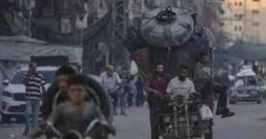
Many residents began fleeing again, loading their belongings onto trucks and carts. However, many expressed despair over the lack of safe shelter.
"There’s no safe place left. We don’t know where to go," said Saddam Yazigi.
Despite the renewed bombardment, around 440 people sheltering at the Holy Family Church chose to remain, along with clergy members.
"When danger comes, we move closer to the walls," said church member Farid Jubran.
The U.N. and other NGOs have also chosen to stay in Gaza City. Yet, the Israeli military did not provide prior notice of the resumed daytime fighting, aid groups said. The Norwegian Refugee Council, which coordinates humanitarian efforts, reported being caught off guard. The U.N. warned that medical services may lose up to half their hospital capacity.
"We cannot serve two million besieged people in the south," said Zaher al-Wahidi, spokesperson for Gaza’s Health Ministry.
This offensive coincides with last week’s declaration of famine in Gaza City by the world’s leading food security agency. An Israeli military source stated they would continue facilitating aid — but did not clarify how that would be done amid the combat.
"This will have a devastating impact on already malnourished, displaced, and traumatized civilians," said the U.N.’s humanitarian office.
Hostage Remains Recovered
Israel also reported the recovery of the remains of two hostages — Ilan Weiss, 55, and another individual who has not yet been publicly identified. Weiss was killed during the October 7 assault on Kibbutz Be’eri.
"We will not stop until every hostage, living or dead, is brought home," said Netanyahu.
Hamas’ military wing, via spokesperson Abu Obeida, said its fighters were prepared for battle in Gaza City and would try to keep remaining hostages alive, but acknowledged fighting is likely near where hostages are being held.
Currently, around 50 of the original 251 hostages remain in Gaza, with 20 believed to still be alive, according to Israeli authorities. Roughly 1,200 Israelis, mostly civilians, were killed in the October 7 attack. Some hostages were released during temporary ceasefires or exchanges.
The Hostages and Missing Families Forum — an advocacy group pushing for hostage recovery — renewed its call for a deal.
"Time is running out. The government must remain at the negotiation table until every last hostage returns," the group stated.