
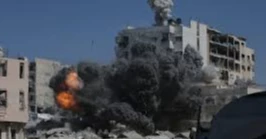
Israeli airstrikes across Gaza City on Saturday killed at least 32 people, including 12 children, as Israel expanded its military campaign and called on civilians to evacuate, according to medical officials.
The bodies were taken to Shifa Hospital, where staff confirmed the toll. The Israeli military has recently escalated its attacks on Gaza City, demolishing high-rise buildings and accusing Hamas of using them for surveillance purposes.
On Saturday, Israeli forces reported targeting another tower used by Hamas in Gaza City. This strike is part of Israel’s wider offensive to seize control of the city, considered Hamas’ final major stronghold. Despite evacuation orders, hundreds of thousands of residents remain trapped amid severe food shortages.
One airstrike overnight in the Sheikh Radwan neighborhood killed a family of 10, including a mother and her three children, health officials said. Mohammed Ramez Sultan, a footballer for the Al-Helal Sporting Club, was also killed along with 14 members of his family, the Palestinian Football Association reported. Footage showed explosions followed by thick smoke clouds.
The Israeli military did not immediately comment on the recent attacks.
Families of Israeli Hostages Protest
In Tel Aviv, families of Israelis held hostage by Hamas protested on Saturday, demanding the government do more to secure their release. They criticized Prime Minister Benjamin Netanyahu’s strategy, particularly a failed Israeli strike on Hamas leaders in Qatar earlier this week.
Einav Zangauker, whose son Matan is among the hostages, condemned the operation as a "spectacular failure." She quoted former U.S. President Trump, saying Netanyahu’s actions sabotage progress in negotiations: “Instead of targeting Hamas leaders, he destroyed our hopes of bringing our loved ones home,” she said.
Evacuation Challenges Amid Worsening Crisis
While some Palestinians are attempting to leave Gaza City in response to Israel’s evacuation orders, many remain due to lack of transportation, financial means, or fear that no place in Gaza is truly safe. Some have already been displaced multiple times and are unwilling to move again.
On Saturday, the Israeli military reiterated its call for civilians to relocate south to designated "humanitarian zones." Spokesman Avichay Adraee claimed over 250,000 people have left Gaza City, though U.N. figures estimate only about 100,000 people have relocated between mid-August and mid-September.
Humanitarian agencies warn that the forced displacement of hundreds of thousands will only worsen the already catastrophic conditions. Shelters in southern Gaza are overcrowded, and many displaced people cannot afford the cost of relocation.
A U.N.-led initiative to bring temporary shelters into Gaza remains stalled, with over 86,000 tents and essential supplies still awaiting entry clearance.
Hunger-Related Deaths Mount
Gaza’s Health Ministry reported that seven more people, including children, died from hunger-related causes in the past day. The total number of malnutrition-related deaths has risen to 420 since the war began, including 145 children.
The latest wave of bombings comes days after Israel targeted Hamas leaders in Qatar, a move that escalated tensions and risked derailing negotiations to end the war.
Hostage families continue to plead with the Israeli government to pause its offensive, fearing it could lead to the deaths of the remaining captives. Of the 48 hostages still believed to be in Gaza, about 20 are thought to be alive.
War Background and Casualties
The conflict began on October 7, 2023, when Hamas-led fighters stormed southern Israel, killing around 1,200 people — mostly civilians — and abducting 251. Israel’s retaliatory military campaign has since killed at least 64,803 Palestinians, according to Gaza’s Health Ministry. Nearly half of those killed were women and children. Major cities have been devastated, and roughly 90% of Gaza’s 2 million residents have been displaced.