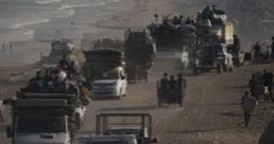
Israeli ground forces, backed by tanks and airstrikes, pressed deeper into Gaza City on Wednesday, marking the second day of a renewed ground offensive that has triggered a mass exodus of Palestinians and drawn widespread international condemnation.
The Israeli military reported over 150 air and artillery strikes in recent days targeting Gaza City ahead of the advance. The strikes have destroyed high-rise buildings in areas heavily populated by displaced families living in makeshift camps. Israel claims these buildings were being used by Hamas for surveillance purposes.
At least 16 people, including women and children, were killed in overnight attacks, according to local hospital officials. Gaza’s death toll has reached nearly 65,000 since the war began on October 7, 2023, with a surprise Hamas-led attack on Israel, Gaza’s Health Ministry said.
Thousands flee amid heavy bombardment
In response to the offensive, large numbers of Palestinians were seen fleeing the city, either by vehicle or on foot. The Israeli military said it had opened a new evacuation corridor south of Gaza City, effective for two days from Wednesday, to allow civilians to leave.
Among the casualties were a mother and child killed in their home at Shati refugee camp. In central Gaza’s Nuseirat refugee camp, an Israeli airstrike hit a house, killing three people, including a pregnant woman, according to Al-Awda Hospital. Another strike in the Muwasi area near Khan Younis killed a family of three — two parents and their child — who were sheltering in a tent.
Gaza’s Health Ministry also reported that Israeli strikes hit the Rantisi Children’s Hospital in Gaza City on Tuesday night, damaging the roof, water tanks, and parts of the interior. The attack forced the evacuation of around 40 patients, while another 40, including four in intensive care and eight premature babies, remained in the facility with a reduced number of medical staff.
The Israeli military said it is reviewing the reported strikes. In past operations, it has accused Hamas of using civilian infrastructure for military purposes.
Colonel Avichay Adraee, the military’s Arabic-language spokesperson, confirmed a new route had been opened for civilians heading south.
Meanwhile, Gaza’s northern regions remain largely cut off from communication. The Palestinian Telecommunications Regulatory Authority reported that Israeli strikes had damaged major network infrastructure, causing internet and telephone outages. Attempts to contact Gaza City residents have been unsuccessful.
Before the renewed offensive, approximately 1 million people lived in the Gaza City area. Israel estimates that 350,000 have since evacuated, while the UN reports that over 238,000 have fled northern Gaza in the last month. Hundreds of thousands remain.
International outcry grows
Humanitarian groups and international organizations have intensified their criticism of the ongoing offensive. A coalition of more than 20 aid organizations, including Save the Children and the Norwegian Refugee Council, issued a joint statement urging governments to take stronger action against what they described as a "genocide" in Gaza.
“This is not only a humanitarian disaster but what the UN Commission of Inquiry has concluded to be genocide,” the statement read. “World governments must take decisive political, economic, and legal action. Rhetoric is no longer sufficient.”
Qatar's Ministry of Foreign Affairs also condemned the ground offensive in the strongest terms, calling it an "extension of the genocide war" against Palestinians. The statement came after five Hamas members and a local security official were killed in an Israeli strike last week.
Israel’s objectives and continued fighting
An Israeli military graphic released on Tuesday suggests that Israel aims to control most of the Gaza Strip, excluding a coastal strip of territory, by the end of the current operation.
While Israel has launched several major operations in Gaza City during the ongoing conflict—often displacing residents and destroying large parts of the city—militants have previously returned after Israeli troops withdrew. This time, Israel has vowed to take full control of the city, which is facing severe food shortages.
A senior Israeli military official, speaking anonymously, estimated that 2,000 to 3,000 Hamas fighters remain in Gaza City, operating in small units and using underground tunnels. Although Hamas’ capabilities have been significantly weakened, it continues guerrilla-style attacks, including planting explosives and ambushing Israeli forces.
Gaza's Health Ministry, staffed by medical professionals and considered credible by the UN and independent observers, said over 64,900 people have been killed since the war began. Roughly half of those are women and children, the ministry added.
The war began when Hamas-led fighters launched a surprise attack on southern Israel on October 7, 2023, killing about 1,200 people—mostly civilians—and taking 251 hostages. Of those, 48 remain in captivity, though fewer than half are believed to be alive.