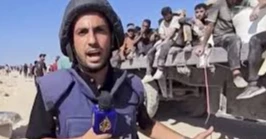
Israel’s recent killing of an Al Jazeera reporter in Gaza has intensified concerns over journalist safety in the region. Even in a war already notorious for its deadly toll on media workers, this incident stands out—raising alarm about how any news is still emerging from Gaza under such extreme conditions.
Despite the dangers, Al Jazeera affirmed on Monday that it will continue its coverage and urged other news outlets to recruit and support more journalists. According to the Committee to Protect Journalists (CPJ), 184 Palestinian journalists and media personnel have died since the war began in October 2023. By comparison, only 18 journalists have died in the Russia-Ukraine conflict.
Israel has largely shut out foreign media from Gaza during the 22-month war, granting access only on rare guided tours. As a result, global audiences rely on Palestinian journalists and local sources to learn what's happening. Israel frequently casts doubt on the objectivity of these journalists, but does not allow others in.
“You’re amazed that any reporting gets done,” said veteran war correspondent Jane Ferguson, founder of Noosphere. She has covered war zones in Syria, South Sudan, and Afghanistan, but said Gaza has been the hardest to report from.
Journalist Anas al-Sharif, aware he was being targeted, left behind a farewell message. He was among eight killed—six of them journalists—when an Israeli airstrike hit near Gaza City’s main hospital on Sunday. Israel claimed he led a Hamas cell but provided no evidence, a claim both Al Jazeera and al-Sharif had rejected.
High Journalist Casualties in Gaza
Major outlets like AFP, AP, BBC, and Reuters are reporting from Gaza, often using local contacts. An August 7 report from the AP described severe hunger: a single bowl of watery eggplant stew feeding a family of six—barely resembling the traditional moussaka once common in Gaza.
Other AP stories have documented the destruction of Gaza’s only Catholic church and followed the lives of young survivors, like an aspiring 18-year-old doctor now living in a tent. Reporters from The Washington Post and The Guardian recently joined a Jordanian aid mission, offering rare aerial views of Gaza’s devastation. As Guardian’s Lorenzo Tondo noted, the territory looked like “the ruins of an ancient civilization.”
Yet, no outlet has delivered the same level of immediacy as Al Jazeera, whose on-camera correspondents have paid the steepest price. CPJ estimates 11 of its journalists and media workers have been killed, more than any other outlet.
In a post prepared before his death, al-Sharif said he had endured deep suffering but never hesitated to tell the truth. “I never once hesitated to convey the truth as it is... so that Allah may bear witness against those who stayed silent,” he wrote.
On August 10, the day of his death, al-Sharif described the trauma of witnessing the aftermath of an Israeli strike. “Body parts and blood were all around us,” he wrote. “When I said it was an ‘indescribable scene,’ I truly meant it—I was helpless.”
Al Jazeera Urges Global Media to Step Up
Salah Negm, Al Jazeera English’s news director, acknowledged the difficulty of sending reporters into Gaza. However, he stressed the importance of utilizing the many educated, trained locals willing to report from the ground. He urged other news organizations to engage more directly.
“We get our reports not just from journalists but also from doctors, aid workers, civil servants,” he said. “People in Gaza want the world to hear them.”
Local journalists often endure the same hardships as those they cover—including food scarcity. Jane Ferguson said she’s never before needed to ask a reporter if they had enough food for themselves or their children.
In a May interview on Democracy Now!, 22-year-old journalist Abubaker Abed explained why he left Gaza to study in Ireland. He was suffering from hunger, and his mother feared his journalism could endanger their family. “If I stayed, I would die,” he said.
Jodie Ginsberg, CPJ’s CEO, warned that the lack of consequences for attacks on journalists sets a dangerous precedent. “They’re basically admitting to a war crime in public,” she said. “And because previous attacks haven’t led to accountability, they can act with impunity.”
Despite the severe conditions, Ginsberg said what’s most striking is that journalists are still finding ways to report from Gaza.