
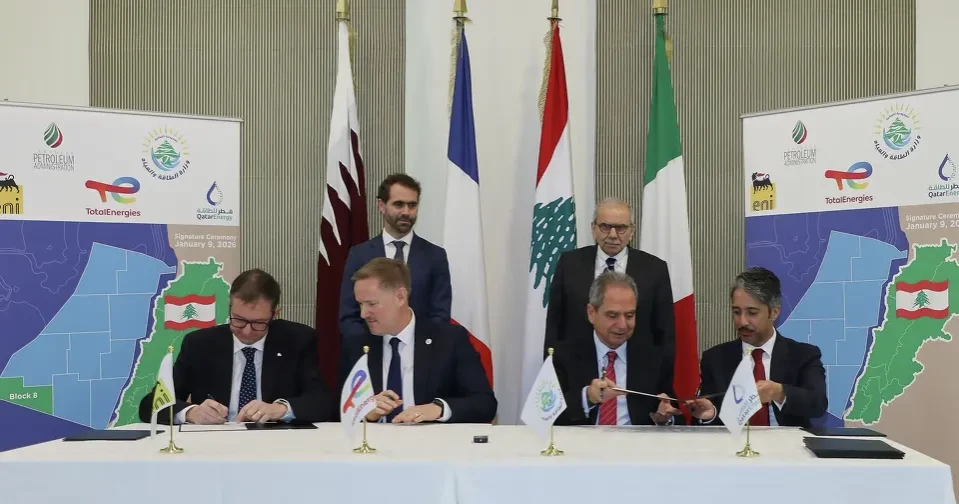
Lebanon’s government on Friday signed an agreement with an international consortium to explore natural gas in an offshore block near its maritime border with Israel, in a fresh bid to tap energy resources and ease its deepening economic crisis.
The deal covers exploration of the so-called Block 8, located off the southern coast of Lebanon, following a 2022 agreement between Lebanon and Israel that settled their long-running maritime border dispute. It is the latest licence granted by Lebanon to foreign companies to search for gas in its territorial waters.
Cash-strapped Lebanon is hoping that potential gas discoveries could help the country recover from the worst financial and economic collapse in its modern history.
The agreement was signed at government headquarters in central Beirut by Energy Minister Joe Saddi on behalf of Lebanon and representatives of the consortium made up of France’s TotalEnergies, Italy’s ENI and Qatar’s state-owned oil and gas company QatarEnergy.
In a statement, TotalEnergies said the consortium plans to begin with a 3D seismic survey covering about 1,200 square kilometres to assess the exploration potential of the area.
Lebanon first awarded offshore exploration licences in 2017 to TotalEnergies, ENI and Russia’s Novatek for two of its 10 Mediterranean blocks, including one that was then partly disputed with Israel. Drilling in the southern block was repeatedly delayed due to the border dispute, while no commercially viable oil or gas was found in a northern block.
Following the 2022 maritime agreement with Israel, offshore drilling resumed in August 2023 but did not yield positive results.
Despite the setback, TotalEnergies Chairman and CEO Patrick Pouyanné said the company remains committed to exploration in Lebanon.
“We remain committed to pursue our exploration activities in Lebanon. We will now focus our efforts on Block 8, together with our partners Eni and QatarEnergy and in close cooperation with Lebanese authorities,” he said.
In January 2023, QatarEnergy joined the consortium after replacing Novatek, taking over its 20 percent stake and acquiring an additional 10 percent from TotalEnergies and ENI, giving the Qatari firm a total stake of 30 percent. TotalEnergies and ENI each hold 35 percent.
Lebanon’s offshore energy plans have also been affected by regional tensions, including the 14-month conflict that began in October 2023 when Hezbollah started firing rockets toward Israeli positions along the border following Hamas’ attack on southern Israel.