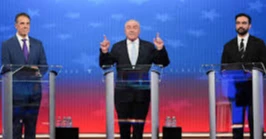
New Yorkers are deciding Tuesday on a generational and ideological shift that could reverberate nationally as they elect the next mayor of the country’s largest city.
Democratic primary winner Zohran Mamdani is facing former Governor Andrew Cuomo, running as an independent, and longtime Republican candidate Curtis Sliwa, who is aiming for a major upset.
A Mamdani victory would make him the city’s first Muslim mayor and its youngest leader in decades, propelling the democratic socialist to national prominence and giving his economic populist agenda a high-profile platform.
If Cuomo prevails, it would mark an extraordinary political comeback just four years after resigning amid sexual harassment allegations as governor.
For Sliwa — founder of the Guardian Angels crime patrol and a familiar New York media figure — winning would place a Republican at the helm of the nation’s largest city at a time when many voters are looking for leadership to counter former President Donald Trump.
The race has made Mamdani a national figure, drawing attacks from Trump and other Republicans, who have painted him as a radical Democrat. Trump has even threatened to “take over” the city and deport Mamdani, who was born in Uganda but is a U.S. citizen, if he wins. On the eve of the election, Trump reluctantly endorsed Cuomo, warning that Mamdani would bring “disaster” and encouraging Sliwa supporters to vote for Cuomo instead.
A Rematch with New Dynamics
Mamdani, 34, a state lawmaker, previously defeated Cuomo in the Democratic primary, energizing progressives with a platform focused on reducing living costs in one of America’s priciest cities.
Cuomo is now appealing to moderates and Republicans, hoping that outgoing Mayor Eric Adams’ late exit and endorsement will help him among centrists, Black voters, and ultra-Orthodox Jewish communities. He has also received backing from former NYC Mayor Michael Bloomberg, who contributed $1.5 million to a super PAC supporting Cuomo in the race’s final days.
Mamdani, meanwhile, has drawn endorsements from prominent progressives like Senator Bernie Sanders and Representative Alexandria Ocasio-Cortez. He proposes taxing the wealthiest New Yorkers to fund free city buses, universal child care, and a rent freeze for around one million regulated apartments.
However, some centrists remain wary due to Mamdani’s past criticism of the NYPD and Israel’s military actions in Gaza, which he labeled genocidal. His refusal to recognize Israel as a Jewish state has also alarmed some Jewish leaders. Though he has softened some of his past rhetoric, several top New York Democrats remain hesitant to endorse him.
The general election will follow a simple plurality system, unlike the city’s ranked-choice primaries.
Sliwa’s Narrow Path
Sliwa’s chances in heavily Democratic New York depend on consolidating Republican support with his tough-on-crime platform while attracting moderates who reject both Mamdani and Cuomo. At 71, he has resisted party pressure to step aside and force a Cuomo-Mamdani runoff. Trump dismissed him as “not exactly prime time,” and Cuomo has sought to siphon off Sliwa supporters, arguing a vote for the Republican could help Mamdani.
Cuomo Runs on Experience, Shadows of the Past
Cuomo, 67, emphasizes his experience managing large government operations in contrast to Mamdani’s relative inexperience. Yet his time as governor is also his vulnerability. He resigned in 2021 after an attorney general report concluded he had sexually harassed at least 11 women, ranging from unwanted advances to groping allegations.
Cuomo initially apologized for some behavior, citing a lapse in workplace judgment. In recent months, however, he has denied wrongdoing, called his accusers liars, and blamed political adversaries for his resignation.