
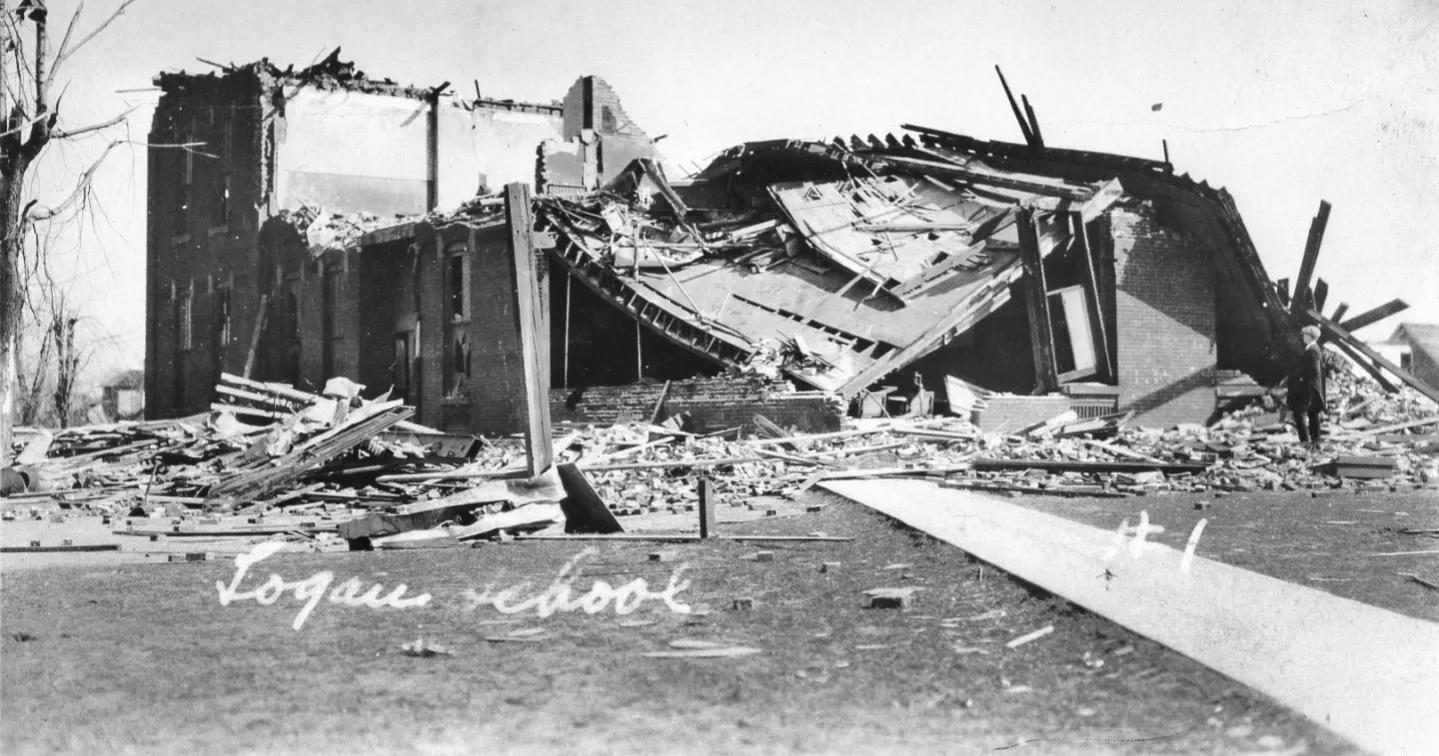
One hundred years ago, an 11-year-old girl, Othella Silvey, stood on the top floor of Logan School, looking for her home just two blocks away. But after a powerful tornado tore through Murphysboro, Illinois, on March 18, 1925, she saw nothing but destruction.
“She couldn’t even tell which direction home was,” recalled her daughter, 81-year-old Sylvia Carvell.
The Deadliest Tornado in U.S. History
The devastating tornado—the deadliest in U.S. history—touched down in southeastern Missouri before cutting a 219-mile (352-kilometer) path of destruction through southern Illinois and into Indiana. Over nearly four hours, it killed 695 people and injured more than 2,000. In addition, at least seven other twisters spun off from the main storm, causing further devastation in Kentucky and Alabama.
By modern classifications, the so-called Tri-State Tornado would be rated an F5, with a mile-wide funnel and wind speeds exceeding 260 mph (418 kph).
One of the most striking examples of its immense force was found at Logan School: a wooden board, four feet (1.22 meters) long and eight inches (20.32 centimeters) wide, embedded so deeply into a maple tree that it could support a man's weight. This artifact is now on display as part of the Jackson County Historical Society’s centennial commemoration of the disaster.
“You hear the statistics—200 mph winds, a mile-wide tornado—but seeing that wooden board driven into a tree makes it real,” said Mary Riseling, who is coordinating the six-day remembrance event. “That piece of wood tells a story on its own.”
A Perfect Storm of Conditions
Meteorologists say a rare combination of atmospheric conditions fueled the tornado’s destructive power. A low-pressure system over the Arkansas-Missouri border merged with a warm front moving north, creating an environment ripe for violent, long-lasting tornadoes, explained Christine Wielgos, warning coordination meteorologist for the National Weather Service.
“That mix provided the warmth, instability, and moisture that, when aligned just right, resulted in one of the most extreme tornadoes in history,” she said.
39 dead as tornadoes, wildfires, dust storms devastate US
Making the disaster even more terrifying was the lack of an early warning system. In 1925, there were no reliable storm forecasts, let alone tornado warnings.
“All people had was a glance at the darkening sky. They didn’t even know what was coming until it was right on top of them, and by then, they were scrambling for shelter,” Wielgos said.
Entire Towns Obliterated
Murphysboro, located 97 miles (156 kilometers) southeast of St. Louis, bore the brunt of the storm. The tornado destroyed 40% of the city and claimed 234 lives—the highest toll in any single municipality. Other towns, including Annapolis, Missouri; Gorham, Illinois; and Griffith, Indiana, were nearly wiped off the map.
The Mobile & Ohio Railroad yards, which employed about 1,100 people, were demolished. In nearby DeSoto, Illinois, the tornado tore through an elementary school, killing 38 children.
The devastation was so profound that it inspired a local song, After the Tornado is Over, which captured the grief and loss:
"I once had a ‘Home Sweet Home’ here,
With families so kind and dear,
The Red Cross tells me they are dead,
Among the debris straight ahead..."
In Murphysboro, Pullman rail cars were repurposed to house visiting medical workers and emergency crews. Meanwhile, the Red Cross set up tents for displaced residents.
Survivors Rebuild Against the Odds
Powerful March storm sparks wildfires, causes fatalities, raises Tornado concerns
In the aftermath of the storm, many assumed the Silvey family had perished, as their home was completely destroyed. Othella and her younger sister, 7-year-old Helen, were sent to Carbondale as orphans. However, it was later discovered that their parents had survived—only their grandparents, who lived nearby, had been killed. The sisters were eventually reunited with their family.
Despite the destruction, Murphysboro and other communities rebuilt. Othella’s family constructed a new home identical to the one they lost. First, they built a small chicken coop, which not only provided shelter but also a crucial food source for months.
To this day, Murphysboro’s west side is dotted with backyard structures—remnants of the temporary shelters families used while rebuilding.
Many of the families who endured the disaster still live in Murphysboro, Riseling noted. Jackson County Historical Society President Laura Cates Duncan said the centennial commemoration not only honors those who died but also celebrates the resilience of the survivors.
“They could have left, but they chose to stay,” Duncan said. “Their roots were here.”
Source: With input from agency