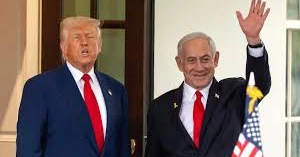
Israeli Prime Minister Benjamin Netanyahu is set to meet with U.S. President Donald Trump in Washington on Monday, amid rising international and domestic pressure to bring an end to the ongoing war in Gaza.
The meeting comes just days after Netanyahu delivered a defiant speech at the United Nations, rejecting global calls for a ceasefire. As Israel becomes increasingly isolated on the world stage and Netanyahu’s ruling coalition faces instability at home, all eyes are now on how Trump—long a vocal supporter of Netanyahu—will approach the discussion.
In a social media post on Sunday, Trump hinted at a breakthrough, writing: “We have a real chance for GREATNESS IN THE MIDDLE EAST. ALL ARE ON BOARD FOR SOMETHING SPECIAL, FIRST TIME EVER. WE WILL GET IT DONE!!!”
The two leaders are expected to hold talks in the Oval Office, followed by a joint press conference.
Analysts say the meeting could prove pivotal. Professor Eytan Gilboa of Bar-Ilan and Reichman universities described it as one of the most critical moments in the Netanyahu–Trump relationship. “Netanyahu may soon have to choose between maintaining support from Trump or holding his fragile coalition together,” he said, noting that several coalition members oppose ending the war.
Researcher Oded Ailam from the Jerusalem Center for Security and Foreign Affairs said Trump is likely to press for a permanent ceasefire, potentially limiting Netanyahu's options. Netanyahu has consistently vowed to continue military operations until Hamas is eliminated.
Should Trump apply pressure, Netanyahu may seek to establish “red lines” in any agreement—such as the dismantling of Hamas and the right to resume military operations if hostilities return.
The Trump-Netanyahu alliance has endured through major events, including a brief military conflict with Iran earlier this year, in which U.S. bombers struck Iranian nuclear sites. Trump also backed Netanyahu during his ongoing corruption trial, calling it a “witch hunt.”
However, tensions have grown. Trump was reportedly frustrated by Israel’s failed operation in Qatar to target Hamas leaders—Qatar being a key U.S. ally and a host of Gaza ceasefire negotiations.
Recently, Trump voiced opposition to Israeli annexation of the West Bank, an idea promoted by hardliners in Netanyahu’s government. Michael Doran of the Hudson Institute argued that Trump’s remarks were strategic, allowing Netanyahu to push back against internal pressure while appearing cooperative with Arab allies.
Last Friday, Trump told reporters that a Gaza deal was “very close,” though past statements have not always led to concrete outcomes.
According to three Arab officials familiar with the U.S. proposal—who spoke anonymously—the plan includes an immediate ceasefire, the release of all hostages within 48 hours, and a phased Israeli military withdrawal from Gaza. The proposal excludes the expulsion of Palestinians, an idea Trump seemed to support earlier this year.
The 21-point plan reportedly calls for Hamas to be disarmed and removed from power. Israel would release hundreds of Palestinian prisoners, including many serving life sentences. An international security force would take over law enforcement in Gaza, while a technocratic Palestinian committee would manage civilian affairs. Eventually, authority would be handed to a restructured Palestinian Authority—though Netanyahu has publicly rejected any PA role in Gaza’s future.
Hamas, informed of the plan by Egyptian and Qatari mediators, has not yet received an official proposal. The group has long refused to disarm, linking its weapons to the goal of achieving an independent Palestinian state.
In an interview with Fox News, Netanyahu acknowledged the U.S. plan, saying Israel was “working with President Trump’s team ... and I hope we can make it a go.”
During his UN speech, Netanyahu praised Trump as a key ally who “understands better than any other leader” the threats faced by both Israel and the United States.
However, international support for Israel has plummeted. At a recent UN Security Council session, while many countries condemned Hamas's October 2023 attack that killed 1,200 Israelis and resulted in 251 hostages, they also criticized Israel’s response and called for an immediate ceasefire and humanitarian aid.
The Gaza Health Ministry, part of Hamas’s administration, says over 66,000 Palestinians have been killed in the conflict. The figure is considered credible by the UN and independent observers. Over 90% of Gaza’s population has been displaced, and famine is spreading.
Twenty-eight Western-aligned nations, once supportive of Israel, have recently urged it to halt military operations and lift aid restrictions. Ten countries—including the UK, France, Canada, and Australia—recognized Palestinian statehood last week, aiming to revive the stalled peace process.
Some Arab states, previously aligned with Israel, have accused it of committing genocide in Gaza. The International Court of Justice is currently reviewing genocide allegations filed by South Africa—claims Israel firmly denies.
Aaron David Miller, a former U.S. adviser on Middle East affairs, said the road to peace remains long and uncertain.
“The more confident the claims that peace is imminent, the more skeptical I become,” he said.