
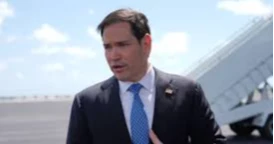
Secretary of State Marco Rubio sought to reassure NATO allies unsettled by President Donald Trump’s sudden policy shifts, but fresh confusion emerged when Trump unexpectedly announced the deployment of 5,000 additional U.S. troops to Poland.
The announcement came only hours after Rubio left for a NATO foreign ministers’ meeting in Sweden, surprising officials because Poland had previously been informed it would not receive the deployment.
At the meeting, Rubio attempted to calm European concerns over Trump’s unpredictable decisions, emphasizing that the United States remains committed to NATO even as it plans to reduce its military presence in Europe over time. Rubio and NATO Secretary-General Mark Rutte both stressed that Washington is consulting allies, though some nations felt blindsided by the abrupt announcements.
Rubio acknowledged that adjustments to the U.S. troop presence in Europe had been under discussion for some time and were coordinated with allies, even if they caused unease. He said the developments should not have come as a complete surprise.
As America’s chief diplomat, Rubio has frequently been tasked with presenting a more measured image of the Trump administration abroad. Earlier this year, he attended the Munich Security Conference and later visited Italy, where he met Italian leaders and Pope Leo XIV following Trump’s criticism of the pontiff.
The NATO meeting in Helsingborg also took place amid uncertainty over the Iran conflict, stalled efforts to end the Russia-Ukraine war, and ongoing frustration in Europe over Trump’s criticism of allies and his interest in Greenland, a Danish territory.
However, the most attention centered on the sudden reversal regarding Poland and a previous announcement about reducing U.S. troop levels in Germany. Rubio defended the decisions, saying the Germany reduction merely returned troop numbers to levels seen three years ago and was not made hastily.
Former U.S. ambassador to Poland Dan Fried criticized the administration’s handling of the situation, describing it as chaotic and poorly managed. While he welcomed the decision to send troops to Poland, he argued that the confusion raised broader concerns about the administration’s commitment to NATO and its ability to manage alliance relations effectively.
Rubio declined to provide details about any further military reductions in Europe, including potential cuts under NATO’s defense contingency plans.
Although Rubio reiterated his strong support for NATO, he also repeated complaints that some allies had not fully supported the U.S. during the Iran conflict. He specifically criticized countries that denied access to American bases or were reluctant to help secure the Strait of Hormuz, an important global oil route affected by Iran’s actions.
Before departing for India, Rubio noted that while nearly all NATO members agree Iran should not obtain nuclear weapons, few countries had actively supported Trump’s efforts to stop Tehran’s nuclear ambitions.