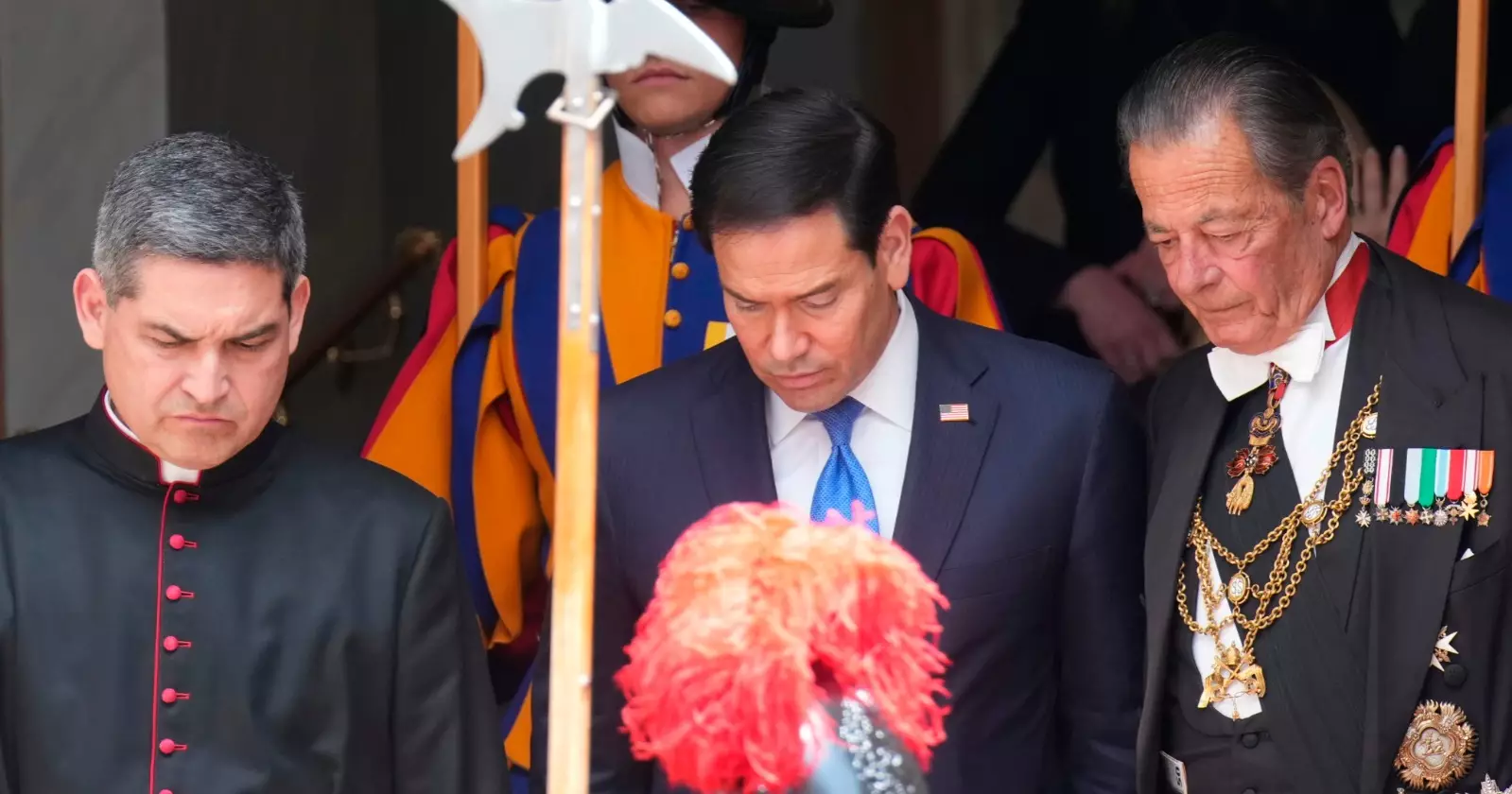
US Secretary of State Marco Rubio was set to meet Italian Prime Minister Giorgia Meloni on Friday as both countries seek to ease growing tensions over the Iran war and broader trans-Atlantic disputes.
Rubio was also scheduled to hold talks with Italian Foreign Minister Antonio Tajani during his visit to Rome.
Differences between Washington and its European allies have deepened in recent weeks over President Donald Trump’s tariff policies, his criticism of Europe’s limited support for the war effort and his remarks targeting Pope Leo XIV.
Rubio began his visit on Thursday with a meeting with Pope Leo XIV at the Vatican, part of a wider US effort to calm tensions with European partners.
Italian leaders are expected to use the meetings to preserve strong ties with Washington while resisting pressure from the US over the Iran conflict.
Trump has criticized both the pope and Italy’s government for opposing the war. Meloni called the conflict “illegal” and described Trump’s comments about the pope as “unacceptable.”
Trump later accused Meloni of lacking courage and being negative about supporting the US in the conflict. Although Meloni was once seen as one of Trump’s closest allies in Europe, relations between the two leaders have reportedly become strained.
Italy has firmly maintained its opposition to involvement in the Iran war.
The US recently announced plans to withdraw 5,000 troops from Germany, while Trump has also threatened to reduce troop deployments in Italy and Spain because of their stance on the conflict.
Italy serves as an important logistics hub for US and allied military operations in the Mediterranean, the Middle East and North Africa. Any reduction in troop numbers could affect NATO’s position in southern Europe.
Defense ties were also tested in March when Italy refused to allow US bombers heading to the Middle East to use the Sigonella air base in Sicily without parliamentary approval.
Under Italy’s constitution and international agreements, military bases can be used for logistics and NATO operations, but direct offensive missions generally require specific authorization.
Meloni and Tajani have repeatedly said Italy does not want to join the Iran conflict. They also stressed that any US request to use Italian bases for offensive military operations would require approval from Parliament, where opposition to the war remains strong.
The war is also creating economic pressure for Italy. Meloni warned that tensions around the Strait of Hormuz are increasing energy costs and hurting household spending, while concerns over possible US tariffs are threatening Italy’s export-driven economy.
Meloni is also under pressure at home after suffering a referendum defeat in March, adding to the political challenges surrounding the war issue.
Since taking office in 2022, Meloni has tried to present herself as a reliable US ally and a bridge between Washington and Europe. But disagreements over Iran and trade have exposed the limits of that role.
At the Vatican on Thursday, Rubio held more than two hours of talks with Pope Leo XIV and Vatican Secretary of State Cardinal Pietro Parolin on efforts to secure lasting peace in the Middle East and other issues of mutual concern.
The US State Department said the meetings reflected strong ties between the United States and the Vatican, with both sides emphasizing peace and human dignity.