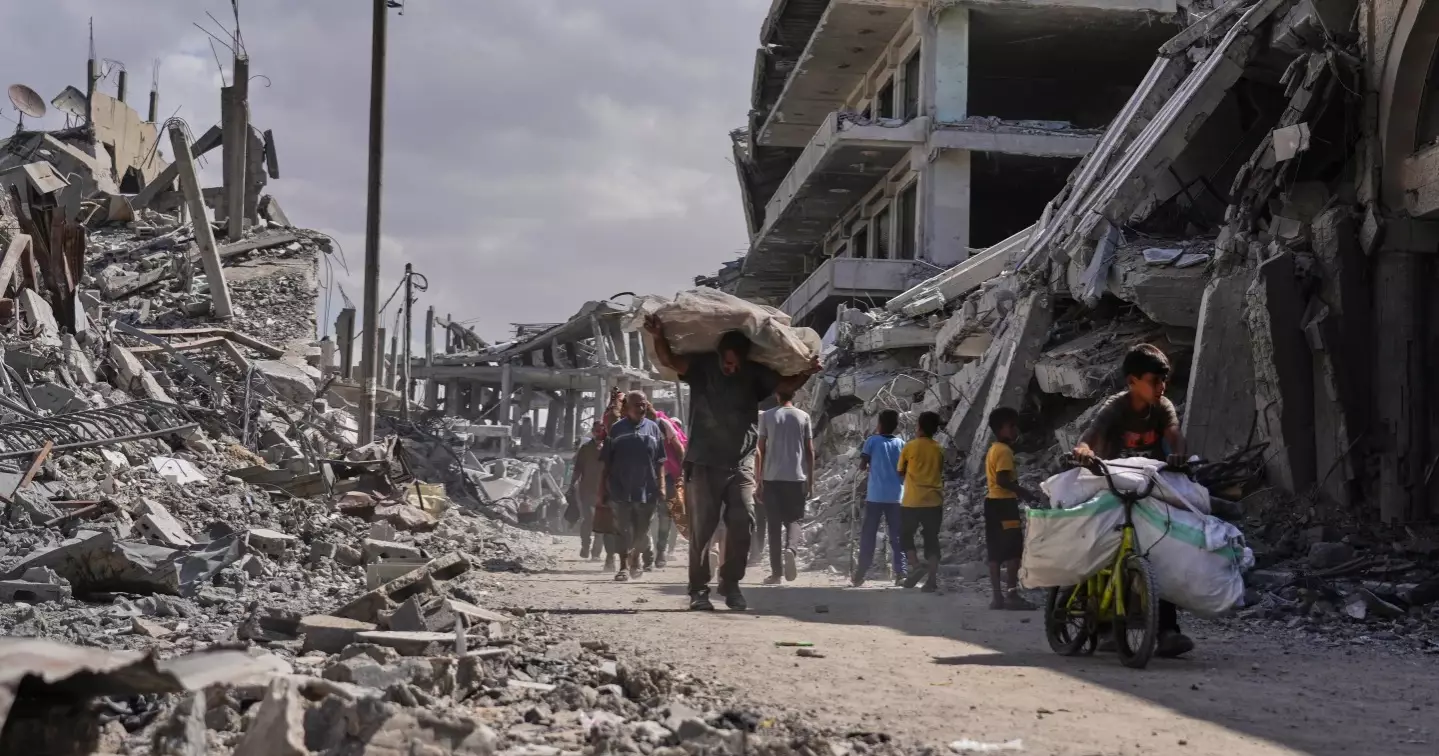
Tens of thousands of Palestinians began returning to the devastated northern Gaza Strip on Friday as a U.S.-brokered ceasefire took effect, raising hopes for an end to the Israel-Hamas war. All remaining hostages are expected to be freed within days under the deal.
Questions remain over who will govern Gaza as Israeli forces gradually withdraw and whether Hamas will disarm, as outlined in U.S. President Donald Trump’s ceasefire plan. Israeli Prime Minister Benjamin Netanyahu, who unilaterally ended a previous truce in March, hinted that Israel could resume its offensive if Hamas refuses to lay down its arms.
The latest truce marks a crucial step toward ending a two-year war that began with Hamas’ attack on Israel in October 2023. The fighting has killed tens of thousands of Palestinians and displaced about 90% of Gaza’s 2 million residents, many of whom now return to find their homes reduced to rubble.
The Israeli military confirmed the start of the ceasefire Friday, saying that 48 hostages — around 20 believed to be alive — will be released by Monday. Palestinians reported that heavy shelling across Gaza subsided after the announcement.
Ceasefire clock starts in Gaza after Israel-Hamas agreement
Netanyahu said in a televised address that Hamas must disarm and Gaza must be demilitarized. “If this can be achieved the easy way, so be it. If not, it will be achieved the hard way,” he warned.
The Israeli military said it would maintain a “defensive presence” in the roughly 50% of Gaza it still controls after pulling back to agreed lines.
UN to begin major aid delivery Sunday
Meanwhile, the United Nations received approval from Israel to start delivering large-scale humanitarian aid into Gaza from Sunday, a UN official said, requesting anonymity as details were not yet public.
The shipments aim to tackle severe hunger and famine conditions caused by Israeli offensives and restrictions on aid. The International Criminal Court has sought the arrest of Netanyahu and his former defense minister for allegedly using starvation as a weapon of war — accusations Israel denies.
The planned aid includes 170,000 metric tons of supplies pre-positioned in neighboring Jordan and Egypt. UN and Israeli officials held extensive talks in Jerusalem over the past 24 hours about delivery routes and entry points.
UN spokesperson Stephane Dujarric said fuel, medicine, and other critical items have started flowing through the Kerem Shalom crossing, while calls continue for Israel to open more border points and ensure safe movement for returning civilians and aid workers.
Israeli forces intercept flotilla bound for Gaza, detain over 140 activists
UN humanitarian chief Tom Fletcher said that in recent months, only 20% of Gaza’s aid needs have been met.
Mass returns amid scenes of destruction
A steady flow of people, most on foot, were seen traveling north along Gaza’s coastal road to check what remained of their homes — a repeat of scenes from a brief truce in January. Others moved south to different parts of the enclave.
The destruction this time is even worse, following Israel’s renewed assault on Gaza City in recent weeks, which leveled high-rises and homes in what Israel said was an effort to eliminate Hamas’ remaining military positions.
“There wasn’t much joy, but the ceasefire somewhat eased the pain of death and bloodshed,” said Jamal Mesbah, displaced from northern Gaza.
In the southern city of Khan Younis, residents returned to find flattened neighborhoods. “There was nothing left — just some clothes, wood, and pots,” said Fatma Radwan, another displaced resident, as people searched for bodies under the debris.
Casualties and humanitarian toll
The war began on October 7, 2023, when Hamas-led militants stormed into Israel, killing about 1,200 people and taking 251 hostages. Israel’s ensuing offensive has killed more than 67,000 Palestinians and injured nearly 170,000, according to Gaza’s Health Ministry, which says about half the dead were women and children.
The conflict has ignited regional tensions, sparked global protests, and prompted genocide allegations that Israel rejects.
Hostage and prisoner releases to begin soon
Under the ceasefire deal, Israel will release around 2,000 Palestinian prisoners in exchange for the remaining hostages. The list released Friday did not include prominent political figure Marwan Barghouti, long seen as a unifying Palestinian leader.
Gaza peace talks gain traction on war’s second anniversary
Senior Hamas official Khalil al-Hayya said all women and children detained in Israeli prisons will be freed. Egyptian and Hamas officials said the releases are expected to begin Monday, though they could start as early as Sunday night.
Relatives of Israeli hostages expressed cautious optimism. “It’s a measured sense of hope,” said Stephen Brisley, whose sister and nieces were killed in the Oct. 7 attack. His brother-in-law was released earlier, but another relative is believed to have died in captivity.
Trump’s postwar plan for Gaza
Under Trump’s ceasefire framework, Israel will retain a long-term military presence along Gaza’s border with Israel. An international peacekeeping force, made up mostly of troops from Arab and Muslim nations, would oversee security inside Gaza, while the U.S. would lead a massive reconstruction effort.
The plan envisions a future role for the Palestinian Authority, subject to major reforms — a condition that could take years to fulfill. It remains vague on the question of a Palestinian state, which Netanyahu continues to oppose.
Source: AP