
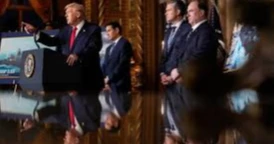
President Donald Trump issued a fresh warning to Venezuelan President Nicolás Maduro on Monday as the United States increased pressure on Caracas, with the Coast Guard stepping up efforts to intercept oil tankers in the Caribbean.
Flanked by senior national security officials, including Secretary of State Marco Rubio and Defense Secretary Pete Hegseth, Trump indicated he is prepared to further ramp up a campaign against Maduro that began four months ago. While initially framed as an effort to curb drug trafficking from Venezuela, the strategy has since broadened in scope.
“If he decides to push back or act tough, that would be the last time,” Trump said during a pause in his Florida vacation, where he also announced plans for the Navy to construct a new large warship.
Trump’s remarks came as the Coast Guard continued pursuing a sanctioned oil tanker for a second straight day. U.S. officials say the vessel is part of a Venezuelan “shadow fleet” used to bypass sanctions, operating under a false flag and subject to a U.S. seizure order.
“It’s on the move, and we’ll eventually take it,” Trump said.
This marks the third tanker targeted by U.S. authorities. On Saturday, the Coast Guard seized the Panama-flagged Centuries, which officials also linked to Venezuela’s covert oil transport network. Earlier this month, another sanctioned tanker, Skipper, was intercepted with Navy assistance.
Following the first seizure, Trump declared that the U.S. would effectively impose a “blockade” on Venezuela and reiterated his view that Maduro’s grip on power is weakening. Last week, he also demanded the return of assets previously taken from U.S. oil companies, again citing the tanker blockade as justification.
Homeland Security Secretary Kristi Noem said the tanker interceptions are meant to send a global message that the Maduro government’s actions will not be tolerated and that Washington intends to protect its interests.
Russian diplomatic families leave Venezuela
At the same time, Russia’s Foreign Ministry has begun removing diplomats’ families from Venezuela, according to a European intelligence official who spoke anonymously due to the sensitivity of the matter. The evacuations reportedly began Friday and include women and children, with Russian officials reportedly viewing the situation in Venezuela as increasingly serious.
Russia denied evacuating its embassy but did not directly address questions about diplomats’ families. Venezuela’s Foreign Minister Yván Gil said he spoke with Russian Foreign Minister Sergey Lavrov, who voiced Moscow’s support for Caracas against the U.S. campaign targeting oil tankers.
Gil accused Washington of violating international law through what he described as attacks on vessels and acts of “piracy” in the Caribbean.
Everyday life near Venezuela’s refineries
Despite the tension at sea, a tanker believed to be part of the shadow fleet was seen moving between Venezuelan refineries over the weekend, including one near El Palito, west of Caracas. The vessel remained docked as families gathered at nearby beaches, enjoying music and the school holiday break.
Longtime local resident Manuel Salazar said the scene contrasts sharply with earlier years, when Venezuela’s oil industry was stronger and multiple tankers lined the bay.
“Back then, you’d see nine or ten ships waiting. Now there’s just one,” Salazar said, noting rising prices and worsening economic conditions.
Transparency watchdog group Transparencia Venezuela has identified the El Palito tanker as part of the shadow fleet. Residents also recalled past New Year’s celebrations, when tankers sounded horns and fireworks lit the sky—traditions that have faded with the country’s economic decline.
On Monday, Venezuela’s pro-government National Assembly gave preliminary approval to legislation that would criminalize activities linked to tanker seizures. The bill would impose heavy fines and prison sentences of up to 20 years for those accused of supporting or participating in what the government calls acts of piracy or illegal blockades.
Meanwhile, under Trump’s direction, the Defense Department continues operations against small vessels in the Caribbean and eastern Pacific that U.S. officials say are involved in drug trafficking. Since early September, at least 104 people have died in 28 such strikes, prompting criticism from lawmakers and human rights groups who question the evidence behind the operations and warn of possible extrajudicial killings.