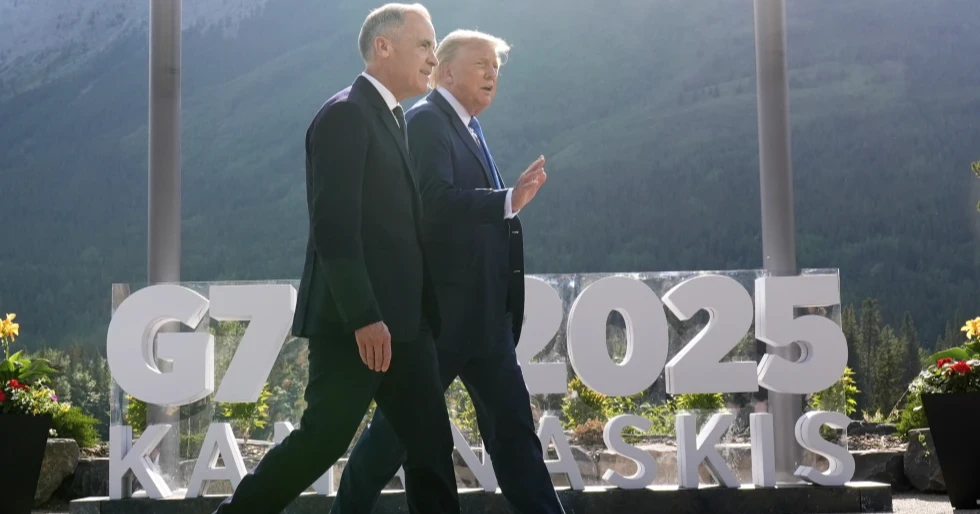
President Donald Trump has announced plans to raise tariffs on a wide range of Canadian imports to 35%, intensifying a growing rift between the two long-time North American allies.
In a letter sent Thursday to Canadian Prime Minister Mark Carney, Trump said the new tariffs—set to take effect on August 1—would replace the existing 25% duties that were imposed in March.
The move is part of Trump’s ongoing pressure campaign on Canada, which he accuses of not doing enough to prevent fentanyl trafficking into the United States, despite data showing that Canada is not a major source of the drug.
Trump also reiterated concerns over the U.S. trade deficit with Canada, which is largely driven by American oil imports.
“The flow of fentanyl is hardly the only challenge we face with Canada, which maintains many tariff and non-tariff barriers,” Trump wrote in the letter.
The announcement rattled global markets, with stock futures falling early Friday. Although recent gains in the S&P 500 had reflected investor optimism that Trump might scale back the tariff hike, the letter appears to have renewed economic uncertainty.
Responding to the move, Prime Minister Carney said Canada remains committed to negotiating a fair trade deal with the U.S. and highlighted his government's efforts to combat fentanyl. “Through the current trade negotiations with the United States, the Canadian government has steadfastly defended our workers and businesses,” he posted on social media.
Trump administration sanctions UN investigator probing Gaza abuses
Carney, who became prime minister in April, campaigned on a promise to adopt a tougher stance in defending Canadian interests. He has since sought to diversify Canada’s trade ties, strengthening partnerships with the European Union and the United Kingdom.
Just hours before Trump’s letter was released, Carney shared a photo with British Prime Minister Keir Starmer on social media, writing, “In the face of global trade challenges, the world is turning to reliable economic partners like Canada”—a veiled criticism of the U.S.'s unpredictable trade policies under Trump.
While several countries have received similar tariff notices from the U.S. in recent days, Canada—America’s second-largest trading partner after Mexico—has become a focal point of Trump’s trade crackdown.
Canada has responded with retaliatory tariffs and rejected Trump's past remarks suggesting it should become the 51st U.S. state.
When Carney went to the White House in May, the public portion of their meeting was cordial. But Trump said there was nothing the Canadian leader could tell him to remove the tariffs, saying, “Just the way it is.”
Daniel Beland, a political science professor at McGill University in Montreal, said Trump's latest move will make it more difficult for Canada and the U.S. to reach a trade deal, Beland said.
“It doesn’t mean a new trade deal between Canada and the United States is impossible, but it shows how hard it is for the Canadian government to negotiate with a U.S. president who regularly utters threats and doesn’t appear to be a reliable and truthful interlocutor,” he said.
Trump has sent a series of tariff letters to 23 countries. Those form letters became increasingly personal with Canada as well as a Wednesday note that put a 50% tariff on Brazil for the ongoing trial of its former President Jair Bolsonaro for trying to stay in office after his 2022 election loss. Trump was similarly indicted for his efforts to overturn his 2020 election loss to Democrat Joe Biden.
Trump administration officials have said that Trump was seeking to isolate its geopolitical rival China with the tariffs, but the latest tariffs have undermined that message. Brazil's largest trading partner is China, not the U.S., and Chinese government officials have framed his import taxes as a form of bullying.
Trump threatens Brazil with steep tariff, demands end to Bolsonaro trial
“Sovereign equality and non-interference in internal affairs are important principles of the U.N. Charter and basic norms governing international relations," said Mao Ning, the Chinese Foreign Ministry spokesman. “Tariffs should not be used as a tool for coercion, bullying and interference in the internal affairs of other countries.”
The letters reflect the inability of Trump to finalize the dozens of trade frameworks that he claimed would be easy to negotiate. Shortly after unveiling his April 2 “Liberation Day” tariffs, a financial market selloff caused Trump to announce a 90-day negotiating period during which a 10% baseline tariff would be charged on most imported goods.
But Trump has indicated that the 10% tariff rates are largely disappearing as he resets the rates with his letters.
“We’re just going to say all of the remaining countries are going to pay, whether it’s 20% or 15%,” Trump said in a phone interview with NBC News.
Trump has announced trade frameworks with the U.K. and Vietnam, as well as a separate deal with China to enable continued trade talks. Trump jacked up import taxes on Chinese goods to as much as 145%, but after talks he has said China faces total tariffs of 55%.
In June, Trump said he was suspending trade talks with Canada over its plans to continue its digital services tax, which would hit U.S. technology companies. A few days later, talks resumed when Carney rescinded the tax.
Under the current tariff structure, the 2020 United States Mexico Canada Agreement has protected eligible goods from Trump's tariffs. But a review of the pact is scheduled for 2026.