
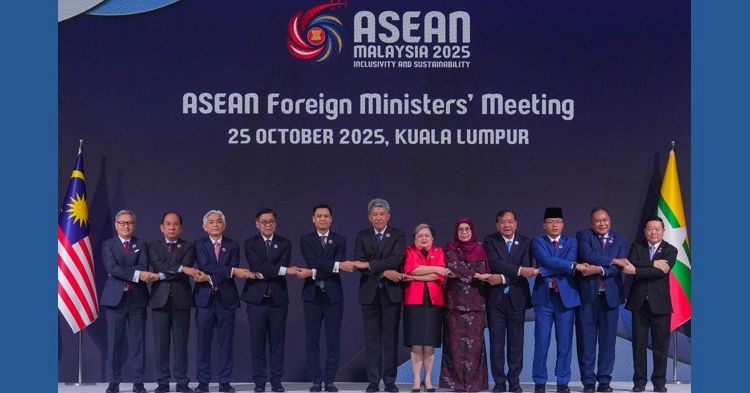
Southeast Asian foreign ministers met Saturday ahead of a pivotal ASEAN summit that will formally admit East Timor as the bloc’s 11th member and mark U.S. President Donald Trump’s first trip to Asia since his return to office.
The two-day Association of Southeast Asian Nations summit, starting Sunday in Kuala Lumpur, will focus on regional security, economic resilience, and maritime disputes, with U.S. tariffs and shifting trade dynamics dominating discussions.
Malaysian Foreign Minister Mohamad Hasan warned that global political “turbulence” threatens ASEAN’s neutrality, urging unity as geopolitical rivalry intensifies. The summit will also revive the Regional Comprehensive Economic Partnership (RCEP), the world’s largest trade bloc, as regional economies seek stability amid Washington’s protectionist trade policies.
Trump’s visit—his first ASEAN appearance since 2017—will feature new U.S. trade agreements and an expanded ceasefire signing between Thailand and Cambodia. Analysts say his presence underscores Washington’s bid to maintain regional influence, even as Trump seeks to project himself as a “global dealmaker” amid strained trade ties.
Security is tight in Kuala Lumpur, with protests planned against Trump’s stance on Palestine. Prime Minister Anwar Ibrahim said Malaysia supports peaceful demonstrations but will ensure smooth proceedings. While acknowledging Trump’s controversial reputation, Anwar praised his mediation in Gaza, though he stressed that Malaysia will press for a lasting Palestinian solution.
A key milestone of this year’s summit is East Timor’s long-awaited ASEAN membership — the first expansion since Cambodia joined in 1999. Anwar hailed the move as strengthening regional inclusivity and solidarity. The young democracy, independent since 2002, hopes ASEAN membership will boost its oil-dependent economy.
Leaders will also tackle regional tensions, including the South China Sea dispute and Myanmar’s ongoing crisis. Myanmar’s military regime remains excluded from ASEAN meetings for failing to implement the bloc’s peace plan, though its upcoming elections have reignited debate over engagement.
Thailand indicated it may send observers to Myanmar’s elections, but insisted the move would not imply endorsement.